Showing posts with label politics. Show all posts

Saturday, August 03, 2024

Who’s in Charge?

In a profile of swing-state Wisconsin where affordable housing is a growing concern with voters, the Wall Street Journal quotes Kayla Lange, who’s struggling to make ends meet, saying, “It’s gotten out of control, and I blame the people in charge.” The story notes that voters ranked housing as their second biggest concern when it comes to high prices—behind only groceries—in a July WSJ poll. The trouble is that the people in charge don’t have much influence on the problem. Ogregores may be a better body to blame and try to affect.

Monday, July 15, 2024

Party ogregores: Biden and the Democratic Party elite

There has been non-stop coverage of President Biden’s frailties since the debate fiasco, examining the motives, actions, and opinions of Biden, people in his inner circle, party operatives, and donors. I’ve started trying to understand, instead, what the Democratic Party elite is up to. Collective agents are largely ignored in our obsession with individuals.

Sunday, November 08, 2020

Gods talking past each other

I’ve been analyzing the recent GAFA hearing in Congress (Online Platforms and Market Power, Part 6: Examining the Dominance of Amazon, Apple, Facebook, and Google), hoping to find evidence for my theory that one can treat technologies and other social forces mythologically.

Friday, July 03, 2020

Counterparts to logos

A Talking Politics podcast about the challenges of political journalism in a deeply polarized age (“Facts vs Opinions,” June 4, 2020) increased my confusion about logos (reason, rationality) vs. mythos. While I’ve been puzzling over how profoundly logos-inflected tech reporting and policymaking seem to be, current events are swamping logos-based journalism with pathos (passion, emotion, sentiment). This post is groping towards ways of thinking about what’s going on today.

Thursday, March 09, 2017

Templates and narratives for change

At the end of a conversation with David Runciman about powerful women on the Talking Politics podcast (reposted on the LRB podcast; their chat starts around 18:00), Mary Beard had this to say:
The idea that women have a model for doing [changing the structures within which women can think of themselves as ambitious, as powerful, as clever, as articulate, and able to make that kind of difference in the world] -- and I don't mean a kind of role model, but I just mean a kind of cultural template for doing that -- until we can provide a narrative and a template, then I think we've got a problem.
This resonates with what I try (and fail) to do in policy innovation. It's not sufficient to have a new idea (= template). You also need to have a story (= narrative) that explains why anyone should care, and why it makes sense.

Saturday, October 20, 2012

Spectrum sharing is not a partisan issue – NOT


After his keynote at Dyspan yesterday, PCAST member Mark Gorenberg and his podium guests (and spectrum report co-authors) Dennis Roberson and Michael Calabrese were asked about the political prospects for the PCAST spectrum sharing recommendations (pdf). I can’t remember exactly who said what, but the message was that spectrum sharing wasn’t a partisan issue. Not so.

Thursday, February 03, 2011

Ways of Knowing

Reading St Augustine’s Confessions reminded me of the Buddhist tradition's three ways of knowing, or "wisdoms": experiential/mystical, cerebral/rational, and learning/textual. (The Pāli terms are bhavana-mayā paññā, cintā-mayā paññā and suta-mayā paññā, respectively.)What strikes me about Augustine is his depth in all three methods; most people seem comfortable in one or at most two of them.

People may debate at cross purposes because they use different approaches to understand the world. Someone who thinks about the world experientially will have difficulty finding common ground with someone grounded in logic, and both may belittle someone who defers to tradition or social norms.

When I shared this idea with Dor Deasy, she pointed out that John Wesley thought faith should be approached from four perspectives: Experience, Reason, Scripture and Tradition, which map to the three above if one combines Scripture and Tradition. According to Wikipedia, the Wesleyan Quadrilateral can be seen as a matrix for interpreting the Bible in mutually complementary ways: “[T]he living core of the Christian faith was revealed in Scripture, illumined by tradition, vivified in personal experience, and confirmed by reason.”

Different personality types approach faith in different ways, though. Peter Richardson’s Four Spiritualities: Expressions of Self, Expression of Spirit uses the Meyers-Briggs personality inventory to characterize an individual’s bent. It may come down to brain physiology: I would not be surprised to learn that some people's brains are built in a way that predispose them to mystical experiences, while others are optimized for logic, or absorbing social norms.

Saturday, December 04, 2010

Heresy as Diagnostic

Heresies, or more exactly, the arguments that lead to one perspective being labeled as orthodoxy and the other as heresy, are pulsing pointers to a religion’s sore spots, those questions of doctrine or practice that have multiple plausible but incompatible answers. Heresy seems to be a useful tool for analyzing a set of beliefs. (Any book recommendations gratefully received.)

I was drawn to the question of heresy by reading Augustine’s Confessions, and Peter Brown’s masterful biography, Augustine of Hippo (1967, 2000). For instance, comparing Augustine and Pelagius, he writes

“The two men disagreed radically on an issue that is still relevant, and where the basic lines of division have remained the same: on the nature and sources of a fully good, creative action. How could this rare thing happen? For one person, a good action could man one that fulfilled successfully certain conditions of behavior, for another, one that marked the culmination of an inner evolution. The first view, was roughly that of Pelagius; the second, that of Augustine.”

My guess is that the choice between solutions that leads to a perspective being labeled heresy is necessary for a consistent set of beliefs, but that something is lost when the choice is made. I’m reminded of Isaiah Berlin’s approach to conflicts of values, summed up thus by John Gray in an interview with Alan Saunders on the Philosopher’s Zone (Australian Radio National, 6 June 2009)

“ . . . the idea that some fundamental concepts of human values are intractable, rationally intractable, in the sense that first of all they can't be resolved without some important loss, and secondly reason is very important in thinking about these conflicts, and then being clear about what they are, what they're between and what's at stake in them. [E]qually reasonable people can come to different judgments as to what ought to be done, so certain types of conflict of value are intractable. . . . So this idea of a kind of fundamental and intractable moral scarcity if you like in human life, such that there have been and there will always be intractable, the conflicts of values, and we can resolve them more or less intelligently in particular contexts that can be more or less skillful and intelligent and reasonable settlements of these conflicts, but they can never be overcome or left behind.”

Such differences may point to a conflict between incommensurable world views. For example, in an article about “relativity deniers”, (Einstein's sceptics: Who were the relativity deniers?, New Scientist 18 November 2010, subscription required) Milena Wazeck explains,

"Einstein's opponents were seriously concerned about the future of science. They did not simply disagree with the theory of general relativity; they opposed the new foundations of physics altogether. The increasingly mathematical approach of theoretical physics collided with the then widely held view that science is essentially simple mechanics, comprehensible to every educated layperson."

I would not be at all surprised if there is at least something like this at play in the argument over climate change; opponents have been all but branded as heretics, and there is religious fervor on both sides.

Monday, February 08, 2010

Resilience and Realpolitik

Resilience is a fashionable meme - rightly so, since it offers an alternative to the "find the efficient optimum" approach to solving problems in political economy. (I would say so, of course; see e.g. my presentation at Silicon Flatirons recently, and my paper on forestry as a metaphor for internet governance.)

As reported by The Economist (A needier era: The politics of global disruption, and how they may change, Jan 28th 2010), a report for the Brookings Institution on international politics in an age of want suggests that Governments should think more in terms of reducing risk and increasing resilience to shocks than about boosting sovereign power.  This is analogous to advocating reducing risk and increasing resilience vs. boosting wealth creation in the economy. The reason given is that the new threats are networks (of states and non-state actors) and unintended consequences (of global flows of finance, technology and so on).

I've seen (and propagated) the same memes in the context technology policy: the determining factors are inter-locking networks of agents, and unintended consequences that shift more quickly than legislation.

It's ironic, given my claim that the resilience approach is a counter to neoclassical economics, that the article closes with a Milton Friedman quote...

Monday, December 21, 2009

Objects of governance: From things to behaviors

In spite of our penchant for abstraction, we think best in concrete terms. That means we prefer to think about things rather than processes, including when it comes to communications regulation. The growing intangibility of our world is making this harder to do, however.

The legal scholar William Boyd introduced me the concept of an “object of governance”, i.e. the explicit focus or nominal topic of regulatory activity. [1] Boyd is concerned with deforestation as an object of climate governance [2]; a quick web search throws up examples like organized crime, “The East”, the Sahel, and risk. Objects of communications regulation include personally identifiable information (PII), spectrum, phone service, and the internet.

While most of these objects are intangible, they are at least to some extent thing-like; they’re nouns. It becomes more tricky when regulation addresses behavior – that is, verbs. I’ll work through a few examples in communications regulation where the object of governance started off as a thing/noun, and is becoming a behavior/verb:

Privacy: From PII to Use

The current approach to protecting privacy on the web is rooted in the notion of data security: information exists somewhere, and needs to be protected. However, an alternative conception based on appropriate use rather than access restrictions is emerging. [3] [4] The idea is that the tradition Notice & Choice regime is complemented by use-and-obligations model where organizations disclose the purposes to which they intend to put information, and undertake to limit themselves to those uses.

Wireless regulation: From spectrum to radio operation

Radio regulation has been framed in terms of government management of a “spectrum asset” for many decades. Even though in practice the regulations concerned themselves with the operating parameters of transmitters, the idea that some underlying asset existed has been a useful fiction, particularly as the detailed technology and service choices have been increasingly privatized through auctions of general-use licenses.

However, a new generation of radio technologies has been used to call this approach into question. “Open Spectrum” advocates have argued that dynamic wireless technologies obviate many underlying assumptions of current regulation, and prefer “commons” access over exclusive licenses. [5] Some in the RF engineering community recommend that regulation take into account dynamic adaptation at all layers in the network stack, not just at the radio layer. [6] I have argued that a static, spectrum-as-asset approach is not a given; a more dynamic radio-as-trademark interference metaphor is perfectly workable. [7]

Universal Service: From telephony to internet access

The Universal Service Fund in the US, and its equivalents in other countries, was conceived of as guaranteeing phone service to those who would not otherwise be able to afford it, particularly in rural communities. There is no a great deal of debate about extending the universal service concept to the internet. However, since internet access can come in an unlimited variety of flavors, it is unclear what the goal of the program should be. Phone service is the same everywhere; but what broadband speed is “good enough”? The regulatory debate is moving away from how to fund phone service to how to define baseline access.

Common carriage: From a neutral network to network management

The most recent of these debates concerns the 21st century equivalent of common carriage for the internet. The rallying cry of Network Neutrality had satisfyingly thing-like connotations: there was a network, and it had to have the attribute of neutrality (noun/adjective). Over time is has largely been agreed that network operators should have some discretion in managing the behavior of their network. The question has now become a behavioral one: what is degree of network management (verb) is appropriate?

Implications

A shift in the objects of governance from things to behaviors suggests a shift in regulation from ex ante to ex post action, that is, from making detailed rules up-front to stating general principles and enforcing breach after the fact. In Law’s Order [8], economist David M. Friedman compares speed limits (ex ante) with reckless driving (ex post), and observes that ex post punishments are most useful when the behavior is determined by private knowledge that the regulator cannot observe.
"Ex ante punishments can be imposed only on behavior that a traffic cop can observe; so far, at least, that does not include what is going on inside my head. Ex post punishments can be imposed for outcomes that can be observed due to behavior that cannot—when what is going on inside my head results in my running a red light and colliding with another automobile."
When an object of governance is thing-like, and changes in the attributes of those things are easily observed – a data breach occurs, some packets don’t cross the network – then ex ante rules are attractive. When governance concerns behavior, particularly behavior that is difficult to observe – the uses to which data is put by a company, whether a particular network management technique discriminates against a competitor – then the regulator has to fall back on ex post enforcement. The difficulties with ex post are well-known, though: from providing sufficient clarity up-front about what would constitute a breach, to the political difficulty of exacting very occasional but very large penalties from powerful players.

Footnotes

[1] Note that this is not the traditional meaning of the term, which used “object” as synonymous with “objective”, e.g. Edmund Burke: “To govern according to the sense and agreement of the interests of the people is a great and glorious object of governance. This object cannot be obtained but through the medium of popular election, and popular election is a mighty evil.”

[2] Boyd, William, “Ways of Seeing in Environmental Law: How Deforestation Became an Object of
Climate Governance”, to be published in Ecology Law Quarterly

[3] Daniel J. Weitzner, Harold Abelson, Tim Berners-Lee, Joan Feigenbaum, James Hendler, Gerald J. Sussman (2007) “Information Accountability”, Computer Science and Artificial Intelligence Laboratory Technical Report, MIT-CSAIL-TR-2007-034, June 13, 2007

[4] Business Forum for Consumer Privacy, “A New Approach to Protecting Privacy in the Evolving Digital Economy: A Concept for Discussion”, March 2009

[5] Kevin Werbach (2003), "Radio Revolution: The Coming of Age of Unlicensed Wireless," New America Foundation and Public Knowledge, no date on document, dated 15 Dec 2003 on NAF site

[6] Preston Marshall (2009) “Quantifying Aspects of Cognitive Radio and Dynamic Spectrum Access Performance” (see slides 15, 16)

[7] J Pierre de Vries, (2008) "De-situating spectrum: Rethinking radio policy using non-spatial metaphors" New Frontiers in Dynamic Spectrum Access Networks, 2008 (DySPAN 2008). http://ssrn.com/abstract=1241342

[8] David M. Friedman, Law's Order: What Economics Has to Do with Law and Why It Matters, Princeton University Press: 2001. See Chapter 7 for a discussion of ex ante/ex post.

Thursday, December 17, 2009

Polling x Lobbying = ?

Polling and lobbying are powerful factors of government that aren’t usually covered in Civics 101. Both are huge industries, and both shape the way political decisions are made. The current wave of web technology is going to create a hybrid form that will reshape politics.

According to 2002 Census data, the marketing research & public opinion polling industry as a whole had revenues of $10.9 billion; special interests paid Washington lobbyists $3.2 billion in 2008 according to the Center for Responsive Politics. Lobbying is as old as politics, but polling is relatively new (19th century), as is its premise: the importance of mass public opinion in government and diplomacy (18th century). Lobbyists are key players in Washington DC, and there’s a revolving door that moves former federal employees into jobs as lobbyists, and that pulls former hired guns into government careers or political appointments. Polling expertise is a key attribute in top political advisors, and something that politicians – and administrations – do incessantly.

The social media technologies of Web 2.0 will create a lobbying/polling hybrid and create a new political power center to rival traditional lobbying and polling. Efforts by government to solicit citizen opinion, like the Ideascale site soliciting input on the National Broadband Plan, or the Open for Questions site run by the White House, are a way for citizens to engage in little-L lobbying. These channels invite manipulation that will amount to big-L lobbying. In the same way that astroturfing co-opted grassroots lobbying, political operatives will co-opt the forms of web 2.0 citizen participation. Those who are adept at viral marketing will propel political memes into real-time polling tools in way that amounts to lobbying.

The amplification of the randomly popular that is pervasive on social rating sites like digg will infuse politics, intensifying the temptations of “poll, then decide”. We’ll also likely see something akin to the hollowing out of the media industry mid-list that The Economist charted in “A world of hits”: In movies and books, both blockbusters and the long tail are doing well; the losers are titles (and retailers) in the not-quite-so-good middle ground. Similarly, blockbuster issues will be laid on for the mass public that doesn’t care about politics (shibboleths like taxes and abortion), and niche lobbying on topics like radio spectrum, prison reform, and privacy will become even more fine-grained. Citizen publics will be important in both: as armies of computer-generated extras in the first case, and as engaged semi-experts in the second. Worthy mid-ground issues like trade, education, and energy policy will get steadily shorter shrift.

One implication is that niche topics like hunger policy shouldn’t strive to move up the charts into the middle ground – they’ll just wither there. Rather, niche players should embrace their residence in the long tail and make the most of Web 2.0 phenomena, like Polling x Lobbying, that give them direct access to the appropriate sliver of the policy making elite.

Saturday, August 01, 2009

Is it, or isn’t it?

Humans are inveterate classifiers. We can’t help ourselves, it seems: we just have to put things in hard-edged categories. Computing might help to blur the edges in a useful way.

An update on the Pluto controversy in New Scientist is a case in point. Discoveries of exoplanets and the anticipation of Earth-size objects in the Kuiper belt make the argument increasingly irrelevant, but yet even professional astronomers seem caught up in arguing for one definition of planets or the other.

Sensory systems like ours are complicated webs of classifiers: whether objects are moving or still, whether movements are animal-like or not, whether something is a face, whether a sound is speech or music, whether someone is a member of our group or not, and endlessly on. Categorization is innate and unavoidable.

But once embedded in culture, it can quickly spiral out into fraught territory. Problems arise because classification has consequences, often monetary, often political. Is that bond AAA or AA? Is that car a clunker or not? Is so-and-so in a special group, or not? Is that judge biased?

The difficulty arises because there are so many parameters that could be used for any classification; people argue about which parameters should count. Does roundness a planet make, or size, or not orbiting around another one, or having swept its orbit clear of other rocks? Cognitive limitations (the four-or-less rule, see e.g. Halford et al. (2004), “How many variables can humans process?” Psychological Science, 16, 70-76) mean that we end up picking a few criteria from the many – too few. And then we require that each criterion must yield a yes/no result, which even for hard science classifications can be contentious: what does it mean for a planet candidate to have “a nearly round shape”?

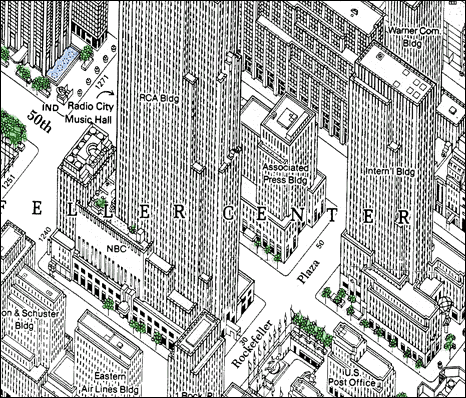
Computing can help by allowing many more criteria into the mix, and allowing them to vary continuously. This is an application of Edward Tufte’s design strategy “to clarify, add detail,” which he introduces in Envisioning Information (1990, p. 37) with the example of The Isometric Map of Midtown Manhattan. Human nature means we may be a little uneasy with the result, but perhaps we can learn to live with it; most people are comfortable nowadays with weather forecasts that say there’s a 50% chance of rain tomorrow (although many may not actually understand what it means ...).

Hiding the criteria has its own dangers. As Bowker and Star argue in Sorting things out: classification and its consequences (1999), any classification encodes a world view, and even “simple” classification systems succeed in making themselves invisible.

Still, with a little more computing we could, in response to the question “Is it, or isn’t it?” answer in a rigorous way, “Ish.” Computers can handle composing dozens or hundreds of continuous criteria in ways our (conscious) brains cannot.

Monday, July 27, 2009

No opponents, but few advocates: Refugee resettlement is like ending hunger

In another installment of her fascinating series on a refugee family resettling in America, Mary Wiltenburg analyzes the big picture in What it’s like to be a refugee in America (Christian Science Monitor, July 19, 2009).

The policy challenge is strikingly similar to the one of ending poverty and hunger in the world. America is remarkably generous (The US, Canada and Australia last year took in 92% of the world's resetlled refugees), but the scope of the problem is tremendous: the US, for example, will resettle about 75,000 people, but 13.6 million others worldwide are living under or seeking UN protection. The American system is creaking: new arrivals received assistance for 24 months when the current system was installed thirty years ago in the Carter Administration, but that's down to a maximum of eight months today.

Wiltenburg's political analysis applies to hunger and poverty, too:

"Refugee resettlement is a tiny program in the grand scheme of Washington. It has no real opponents, but advocates all have higher priorities and the refugees themselves have no political clout. It’s widely agreed that the program’s funding is due for a radical increase [but] how any politician will weigh the moral and political costs against the financial one is still a question."

National security rationales are often used to lobby for international relief programs of all kinds, but the logic is usually tenuous. The true motivation is compassion and generosity, which is unfortunately antithetical to the competitive tussle over resources that is the essence of politics.

Wednesday, July 15, 2009

Factoid: America has < 5% of the world’s people but almost 25% of its prisoners

Source:"A nation of jailbirds," Lexington opinion column in the The Economist, 4th April 2009.
"It imprisons 756 people per 100,000 residents, a rate nearly five times the world average. About one in every 31 adults is either in prison or on parole. Black men have a one-in-three chance of being imprisoned at some point in their lives."
The first half of the story is a searing list of statistics on the brutality and ineffectiveness of the US prison system. But the point is that there's a politician who seems to have taken up this most unpopular of all issues in a democracy (after the rights of sex offenders): Sen. Jim Webb of Virginia.

Sunday, January 18, 2009

Voting within the Margins

Al Franken seems (for now, at least) to have won the Minnesota Senatorial election by 225 out of a total of about 3 million ballots cast: a margin of 0.0001, or 0.01%.

This margin of error is tiny; it's of the same order as the difference in length of your car between a day that's freezing and one that's in the 80's. (See here for steel's coefficient of thermal expansion if you want to check my math.)

This is so small that the result is a toss-up for all practical purposes. Presumably, however, society cannot accept that election results are random; we have to pretend that certainty can be had.

The margins of error of the voting process are sometimes larger than the margin of victory of the winner; this was certainly the case in Minnesota. Philip Howard of the University of Washington found seven such cases in the 2004 elections ("In the Margins: Political Victory in the Context of Technology Error, Residual Votes, and Incident Reports in 2004," 1/6/2005, PDF). He used three ways of thinking about error in an election: technology error, residual votes, and incident reports. For example, Howard cites a 2000 Caltech/MIT which found that the error rates for a large variety of vote counting processes were all 1% or more. (Recall that the margin of victory in Minnesota was one-one hundredth of this: 0.01%) He concludes: "In each case, the electoral outcome was legitimated by elections officials, not the electorate, because in very close races the voting process cannot reveal electoral intent."

In Minnesota, with all the recounts, many of those errors were removed. But there are many kinds of randomness in an election beyond the measurement: someone absent-mindedly ticking the wrong box, someone else deciding at random not to vote on a given day, or people who mistake one candidate for another. In the end, we just don't know the answer, and a coin toss (whether overt or hidden) is a fine way to decide the result. If it was a bad choice, the electorate can throw the bum out next time.

Monday, August 25, 2008

The Soreness of Losing – Clinton Edition

A dark cloud of cranky Clintonism is hanging over the Democratic convention in Denver. Dark muttering about not supporting Obama because Clinton (either one) was disrespected just won’t go away.

There are many plausible explanations, including egotism, frustrated feminism and the Boomer/GenX divide. I rather like an appeal to the psychological phenomenon of loss aversion: people feel a loss more keenly than a gain.

Technically, loss aversion is the tendency to prefer avoiding losses over acquiring equivalent gains. I like to think of it this way: Imagine a store selling widgets. They can either sell them for $100, and offer a 5% discount for cash, or sell them at $95 but impose a $5 surcharge for someone buying with a credit card. The discount feels like a gain to the cash customer, and the surcharge feels like a loss to the credit card buyer. The net effect is the same, but the loss is felt more keenly than the gain. Therefore, stores will more likely post the credit card price and offer cash discount than impose a surcharge.

Clinton supporters went into the primary campaign assuming that they were going to win. Obama’s win is a keen loss to them; something that these people felt they already “had” is being taken away. For the Obamans, on the other hand, the win was a bonus; they never really expected it. They’re happy about it, of course, but don’t feel it as profoundly as the Clintonistas feel their loss.

There is probably little that the Obama campaign can do to assuage their pain. The best hope for the Democratic party is the operation of another cognitive bias: the tendency for people to overestimate the length or the intensity of an emotion, known as impact bias. Even though the Clintonistas may not feel that way now, by the time the November election comes around their current disaffection will have passed, and they will vote the Democratic ticket.

Thursday, June 12, 2008

Gender politics, big and small

I sense a lot of suppressed anger, and not just disappointment, among Hillary’s frustrated female supporters.

In a New York Times report this morning about Obama’s struggle to tap into Clinton’s donor base, Susie Tompkins Buell, a wealthy longtime friend of Mrs. Clinton, said she wanted to see how Mrs. Clinton was treated over the next few weeks, a sentiment that she said was shared by many of the women, especially, in her donor network. The Times says that for some, it is a matter of ensuring that Mrs. Clinton gets the proper credit, while others are waiting for the chance to question Mr. Obama.

This reminded me of a quote in a story that the Times ran yesterday about what same-sex couples can teach everyone else about marriage and relationships. Esther D. Rothblum, a professor of women’s studies at San Diego State University reportedly said that heterosexual married women live with a lot of anger about having to do the tasks not only in the house but in the relationship.

Monday, December 26, 2005

Law as Code

Larry Lessig broke through to celebrity with his book Code and Other Laws of Cyberspace. He argues that the writers of software code create frames for behavior that can be as coercive as the law. I’ve started wondering about the reverse: treating laws as if they were software.

Our intuitions are grounded in how our brains use our bodies to interact with the physical world. Software confounds those intuitions because it’s doubly inexhaustible: it’s made up of ideas which can’t be “used up”, and the resulting product is itself perfectly copiable infinitely many times. Both the input and the output of manufacturing software is non-rivalrous, to use the economic jargon.

As we build a knowledge economy, we are surrounding ourselves with abstractions for which our body-based reasoning is ill-prepared. Examples beyond software include quantum mechanics, persistent exponential growth (eg Moore’s Law for silicon chips) and products built on pure probability (eg futures markets, and lotteries in general). Not all of this is novel, though. Laws, lotteries and logic have been around for millennia. However, people at large have not had to worry about their weirdness because they have only been parochial concerns to date. The pervasiveness of software can open our eyes – especially if we’re geeks and not wonks – to some of the curious properties of law.

One can think of the legal code as the operating system for a country. If the laws are the operating system, then contracts are the applications. There are many more contract lawyers that lobbyists, just as there are many more applications than operating systems.

The amount of code in a software program can be measured by counting the number of lines of source code, that is, the number of lines of human-readable instructions. Contemporary operating systems contain tens of millions of lines of code (Wikipedia cites line counts for some common operating systems).

I was surprised when I totaled up the number of lines in the US Code, the compendium of all the (federal) laws of the United States: about 5 million lines (spreadsheet). That’s about the same size as Windows NT or the Linux 2.6.0 kernel, at 4 million and 6 million lines of source code, respectively.

The “core development team” for the US Code is rather smaller than that for Windows or Linux, which are both said to be in the region of 8,000 people. The Washington DC legislature consists of 50 senators, 400-odd members of the House, and their legislative staff. If we assume a member to staff ratio of 1:3, that’s a team of 1,800 “developers”. Of course, one can’t forget the lobbyists, many of whom are lawyers who do the actual legislative drafting. Roberta Baskin, Executive Director of The Center for Public Integrity estimates that the federal lobbying industry employs about 14,000 people to influence the decisions of Congress, the White House, and officials at more than 200 federal agencies. Not all 14,000 are working on the US Code; many are working on agency regulations, which geeks might want to think of as the “middleware” of the legislative machine. (Note that I’ve ignored state law and local regulations in this approximation; it shouldn’t change the answer by more than about a factor of 2.) In all, the number of people writing the operating system for the United States is approximately the same size as the teams working on PC operating systems.

The analogy offers endless opportunities for harmless fun and mischievous comparisons.

Developers and lawyers quite similar: both write code, both worry about misplaced punctuation marks that could ruin everything, and both spend a lot of time on “edge cases”. Neither has ever seen a piece of code that they couldn’t do better, and both spend more time maintaining and tweaking legacy code than writing new stuff. However, it may take a little while for the maintenance of the US Code to be off-shored to India…

Legislation is infested with inconsistency; software tools that track links between code modules could help find discrepancies. S. remembers that her family was perplexed by what to do about an old tree in their garden. One regulation insisted that they cut it down, because it was old and rotten, and another insisted that it be protected, because it was just plain old. (They cut it down.) On the other hand, while tools can find buffer overflows in software, one needs the CBO to find budget overflows since legislation is code which is designed to run in the future, and have its worst side-effects when its drafters have happily retired to working as lobbyists.

One could see most of the activity in national and state capitals as the frantic “patching” of unintended side-effects in legal code. Tax lawyers seeking loopholes and hackers looking for trapdoors have similar goals – making the code do something it was not designed for. Unfortunately, it takes rather longer to patch the legal code than it does to issue a security update.

The judicial system is the “execution environment” for the code the makes up the code for a country. (In country as enamored of the death penalty as the United States, that computing term is more accurate than one might wish.) The courts figure out what the legal code actually does in practice. The function of the courts highlights a weakness in my analogy: laws are written in ordinary language with all its delightful vagueness, whereas computer code is written in mathematical symbols dressed up to look like language. In software, ambiguity is a bug; in law, it’s often a feature.