In lecture 27 of the Teaching Company course on Understanding the Brain, Jeanette Norden observes that we seem to learn morality using the same mechanisms we use for learning language.
Newborns can form all the sounds used in all the languages on the planet, but with exposure to their mother tongue they become fluent in a subset. It eventually becomes almost impossible to form some of unused sounds, and the idiosyncrasies of their language seem natural and universal.
This makes me wonder about the difficulties an immigrant might have in learning the peculiarities of a new culture. I’ve definitely been confounded from time to time by unexpected variations in “the right thing to do” – and there’s really very little difference between the culture I grew up in and the ones I moved to as an adult. “Culture shock” may not just be language and customs; it probably involves morality, too, since every system of ethics is a mixture of universals and particulars.
Of course, that’s not to say that one cannot become fluent in an alternative morality. It might just be harder than a native “moralizer”, particularly one who has never had to learn "ethics as a second language”, might assume.
And traditionalists around the world who claim that wall-to-wall American media “corrupt the morals of our youth” are probably right: I'd guess young people pick up the ethical biases of American culture by watching movies and TV even more easily than they pick up English.
Showing posts with label cognition. Show all posts
Showing posts with label cognition. Show all posts
Tuesday, May 11, 2010

Saturday, April 24, 2010
Knowing with the Body
The neurological patient known as Emily cannot recognize the faces of her loved ones, or even herself in a mirror. [1] She doesn’t have conscious awareness that she knows these people, but her body does. When she is shown a series of photos of known and unknown people, she cannot tell them apart; however, the electrical conductance of her skin increases measurably when she’s looking at the face of someone she knows. [2] It’s not that she’s lost the ability to recognize people in general; she can still recognize her family, and herself, by their voices.
Damasio notes that skin-conductance responses are not noticed by the patient. [3] However, perhaps someone who is well-practiced in observing body sensations – for example, a very experienced meditator in the Burmese vipassana tradition [4] – would be able to discern such changes. I suspect so; in which case, a patient like Emily would be able to work around their recognition problem by noting when their skin sensations change. It’s known that they use workarounds; Emily, for example, “sits for hours observing people’s gaits and tries to guess who they are, often successfully.” [5]
Both Damasio’s theory of consciousness and Burmese vipassana place great importance on the interactions between body sensations and the mind. As I understand Damasio, he proposes that consciousness works like this:

In Emily’s case, steps 1 and 2 function perfectly well, but the correlation between a face and changes in the body fails in step 3. The higher-order correlation still works for voices and body changes, however, since she can recognize people by their speech.
More acute awareness of body sensation might not just help clinical patients like Emily. In the famous Iowa Gambling Task, Damasio and Antoine Bechara showed that showed that test subjects were responding physiologically (again, changes in skin conductance) to risky situations long before they were consciously aware of them. A 2009 blog post by Jonah Lehrer includes a good summary of the Iowa Gambling Task and its results. Lehrer reports new research indicating that people who are more sensitive to “fleshy emotions” are better at learning from positive and negative experiences.
NOTES
[1] This post is based on material in Antonio Damasio’s book The Feeling of What Happens: Body and Emotion in the Making of Consciousness (Harcourt 1999). Emily’s case is described on p. 162 ff. I also blogged about this topic in 2005 after reading “Feeling” for the first time.
[2] Damasio op. cit. [1], p. 300
[3] Ibid.
[4] For example, vipassana as taught by S N Goenka. Other mindfulness meditation traditions also attend to body sensations (see e.g. Phillip Moffitt, “Awakening in the Body”, Shambhala Sun, September 2007) but the Burmese tradition places particular emphasis on it.
[5] Damasio op. cit. [1], p. 163
[6] Damasio, A. (2001) "Fundamental feelings", Nature 413 (6858), 781. doi:10.1038/35101669. Note that Damasio’s definition of “emotion” is narrower than usual usage, which refers to affective states of consciousness like joy, sorrow, fear, or hate. Damasio limits himself to the physiological changes which are more typically considered to be an accompaniment to, or component of, these mental agitations.
[7] Feelings so defined seem to correspond to what S. N. Goenka, a well-known teacher in the Burmese vipassana tradition, calls sensations, his preferred translation of the Pāli term vedanā, also often translated as “feelings”. There is some debate about whether vedanā refers just to sensations-in-the body, as Goenka contends, or to any and all pleasant, painful or neutral feelings such as joy, sorrow, etc.
Damasio notes that skin-conductance responses are not noticed by the patient. [3] However, perhaps someone who is well-practiced in observing body sensations – for example, a very experienced meditator in the Burmese vipassana tradition [4] – would be able to discern such changes. I suspect so; in which case, a patient like Emily would be able to work around their recognition problem by noting when their skin sensations change. It’s known that they use workarounds; Emily, for example, “sits for hours observing people’s gaits and tries to guess who they are, often successfully.” [5]
Both Damasio’s theory of consciousness and Burmese vipassana place great importance on the interactions between body sensations and the mind. As I understand Damasio, he proposes that consciousness works like this:
1. The brain creates representations (he calls them maps or images) of things in the world (e.g. a face), and of the body itself (e.g. skin conductance, position of limbs, state of the viscera, activity of the muscles, hormone levels).Since I find pictures to be helpful, I’ve created a short slide animation on SlideShare that shows my understanding of this process; click on this thumbnail to go there:
2. In response to these representations, the brain changes the state of the body. For example, when it sees a certain face, it might change skin conductance; when it discerns a snake it might secrete adrenaline to prepare for flight, tighten muscle tone, etc. Damasio calls these responses “emotions”, which he defines as “a patterned collection of chemical and neural responses that is produced by the brain when it detects the presence of an emotionally competent stimulus — an object or situation, for example.” [6]
3. In a sufficiently capable brain (which is probably most of them) there is a higher order representation that correlates changes in the body with the object that triggered these changes. This second-order map is a feeling, in Damasio’s terminology: “Feelings are the mental representation of the physiological changes that characterize emotions.” [6], [7] Feelings generate (or constitute – I’m not sure which…) what he calls the “core self” or “core consciousness”.
In Emily’s case, steps 1 and 2 function perfectly well, but the correlation between a face and changes in the body fails in step 3. The higher-order correlation still works for voices and body changes, however, since she can recognize people by their speech.
More acute awareness of body sensation might not just help clinical patients like Emily. In the famous Iowa Gambling Task, Damasio and Antoine Bechara showed that showed that test subjects were responding physiologically (again, changes in skin conductance) to risky situations long before they were consciously aware of them. A 2009 blog post by Jonah Lehrer includes a good summary of the Iowa Gambling Task and its results. Lehrer reports new research indicating that people who are more sensitive to “fleshy emotions” are better at learning from positive and negative experiences.
NOTES
[1] This post is based on material in Antonio Damasio’s book The Feeling of What Happens: Body and Emotion in the Making of Consciousness (Harcourt 1999). Emily’s case is described on p. 162 ff. I also blogged about this topic in 2005 after reading “Feeling” for the first time.
[2] Damasio op. cit. [1], p. 300
[3] Ibid.
[4] For example, vipassana as taught by S N Goenka. Other mindfulness meditation traditions also attend to body sensations (see e.g. Phillip Moffitt, “Awakening in the Body”, Shambhala Sun, September 2007) but the Burmese tradition places particular emphasis on it.
[5] Damasio op. cit. [1], p. 163
[6] Damasio, A. (2001) "Fundamental feelings", Nature 413 (6858), 781. doi:10.1038/35101669. Note that Damasio’s definition of “emotion” is narrower than usual usage, which refers to affective states of consciousness like joy, sorrow, fear, or hate. Damasio limits himself to the physiological changes which are more typically considered to be an accompaniment to, or component of, these mental agitations.
[7] Feelings so defined seem to correspond to what S. N. Goenka, a well-known teacher in the Burmese vipassana tradition, calls sensations, his preferred translation of the Pāli term vedanā, also often translated as “feelings”. There is some debate about whether vedanā refers just to sensations-in-the body, as Goenka contends, or to any and all pleasant, painful or neutral feelings such as joy, sorrow, etc.
Saturday, August 01, 2009
Is it, or isn’t it?
Humans are inveterate classifiers. We can’t help ourselves, it seems: we just have to put things in hard-edged categories. Computing might help to blur the edges in a useful way.
An update on the Pluto controversy in New Scientist is a case in point. Discoveries of exoplanets and the anticipation of Earth-size objects in the Kuiper belt make the argument increasingly irrelevant, but yet even professional astronomers seem caught up in arguing for one definition of planets or the other.
Sensory systems like ours are complicated webs of classifiers: whether objects are moving or still, whether movements are animal-like or not, whether something is a face, whether a sound is speech or music, whether someone is a member of our group or not, and endlessly on. Categorization is innate and unavoidable.
But once embedded in culture, it can quickly spiral out into fraught territory. Problems arise because classification has consequences, often monetary, often political. Is that bond AAA or AA? Is that car a clunker or not? Is so-and-so in a special group, or not? Is that judge biased?
The difficulty arises because there are so many parameters that could be used for any classification; people argue about which parameters should count. Does roundness a planet make, or size, or not orbiting around another one, or having swept its orbit clear of other rocks? Cognitive limitations (the four-or-less rule, see e.g. Halford et al. (2004), “How many variables can humans process?” Psychological Science, 16, 70-76) mean that we end up picking a few criteria from the many – too few. And then we require that each criterion must yield a yes/no result, which even for hard science classifications can be contentious: what does it mean for a planet candidate to have “a nearly round shape”?
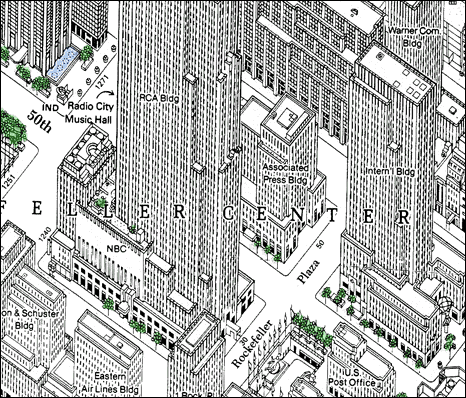
Computing can help by allowing many more criteria into the mix, and allowing them to vary continuously. This is an application of Edward Tufte’s design strategy “to clarify, add detail,” which he introduces in Envisioning Information (1990, p. 37) with the example of The Isometric Map of Midtown Manhattan. Human nature means we may be a little uneasy with the result, but perhaps we can learn to live with it; most people are comfortable nowadays with weather forecasts that say there’s a 50% chance of rain tomorrow (although many may not actually understand what it means ...).
Hiding the criteria has its own dangers. As Bowker and Star argue in Sorting things out: classification and its consequences (1999), any classification encodes a world view, and even “simple” classification systems succeed in making themselves invisible.
Still, with a little more computing we could, in response to the question “Is it, or isn’t it?” answer in a rigorous way, “Ish.” Computers can handle composing dozens or hundreds of continuous criteria in ways our (conscious) brains cannot.
An update on the Pluto controversy in New Scientist is a case in point. Discoveries of exoplanets and the anticipation of Earth-size objects in the Kuiper belt make the argument increasingly irrelevant, but yet even professional astronomers seem caught up in arguing for one definition of planets or the other.
Sensory systems like ours are complicated webs of classifiers: whether objects are moving or still, whether movements are animal-like or not, whether something is a face, whether a sound is speech or music, whether someone is a member of our group or not, and endlessly on. Categorization is innate and unavoidable.
But once embedded in culture, it can quickly spiral out into fraught territory. Problems arise because classification has consequences, often monetary, often political. Is that bond AAA or AA? Is that car a clunker or not? Is so-and-so in a special group, or not? Is that judge biased?
The difficulty arises because there are so many parameters that could be used for any classification; people argue about which parameters should count. Does roundness a planet make, or size, or not orbiting around another one, or having swept its orbit clear of other rocks? Cognitive limitations (the four-or-less rule, see e.g. Halford et al. (2004), “How many variables can humans process?” Psychological Science, 16, 70-76) mean that we end up picking a few criteria from the many – too few. And then we require that each criterion must yield a yes/no result, which even for hard science classifications can be contentious: what does it mean for a planet candidate to have “a nearly round shape”?
Computing can help by allowing many more criteria into the mix, and allowing them to vary continuously. This is an application of Edward Tufte’s design strategy “to clarify, add detail,” which he introduces in Envisioning Information (1990, p. 37) with the example of The Isometric Map of Midtown Manhattan. Human nature means we may be a little uneasy with the result, but perhaps we can learn to live with it; most people are comfortable nowadays with weather forecasts that say there’s a 50% chance of rain tomorrow (although many may not actually understand what it means ...).
Hiding the criteria has its own dangers. As Bowker and Star argue in Sorting things out: classification and its consequences (1999), any classification encodes a world view, and even “simple” classification systems succeed in making themselves invisible.
Still, with a little more computing we could, in response to the question “Is it, or isn’t it?” answer in a rigorous way, “Ish.” Computers can handle composing dozens or hundreds of continuous criteria in ways our (conscious) brains cannot.
Monday, March 17, 2008
Tools make the solution
In an example of how tools shape thinking, New Scientist reports on a study where using Mathematica led students to focus on the computational aspects of a problem, rather than trying to understand the underlying physics. (Mark Buchanan, "Physics tool makes students miss the point" 8 January 2008; source paper by Bing & Redish)
Mathematica frees scientists from the drudgery of solving equations by hand - but first you have to devise a solution strategy. Apparently this is a broader problem: automated thinking tools prevent people from thinking about the broader context of the problem they face.
I have to wonder whether the quants on Wall Street (and their bosses) were so wrapped up in their computer models that they didn't think about the underlying risks of sub-prime derivatives, or the moral hazard of decoupling the mortgage reseller from the consequences of a loan going bad.
In a version of "you get what you measure", here "the solution is determined by the tool."
Mathematica frees scientists from the drudgery of solving equations by hand - but first you have to devise a solution strategy. Apparently this is a broader problem: automated thinking tools prevent people from thinking about the broader context of the problem they face.
I have to wonder whether the quants on Wall Street (and their bosses) were so wrapped up in their computer models that they didn't think about the underlying risks of sub-prime derivatives, or the moral hazard of decoupling the mortgage reseller from the consequences of a loan going bad.
In a version of "you get what you measure", here "the solution is determined by the tool."
Thursday, September 20, 2007
Why we need stories
One might be able to explain the Nassim Taleb's “narrative fallacy” (see The Black Swan) partly by invoking Patrick Leman’s “major event, major cause” reasoning. Leman describes it thus in The lure of the conspiracy theory (New Scientist, 14 Jul 07):
“Essentially, people often assume that an event with substantial, significant or wide-ranging consequences is likely to have been caused by something substantial, significant or wide-ranging.
“I gave volunteers variations of a newspaper story describing an assassination attempt on a fictitious president. Those who were given the version where the president died were significantly more likely to attribute the event to a conspiracy than those who read the one where the president survived, even though all other aspects of the story were equivalent.
“To appreciate why this form of reasoning is seductive, consider the alternative: major events having minor or mundane causes - for example, the assassination of a president by a single, possibly mentally unstable, gunman, or the death of a princess because of a drunk driver. This presents us with a rather chaotic and unpredictable relationship between cause and effect. Instability makes most of us uncomfortable; we prefer to imagine we live in a predictable, safe world, so in a strange way, some conspiracy theories offer us accounts of events that allow us to retain a sense of safety and predictability.”
Taleb’s account of our inclination to narrate is psychological: “It has to do with the effect of order on information storage and retrieval in any system, and it’s worth explaining here because of what I consider the central problems of probability and information theory. The first problem is that information is costly to obtain. . . The second problem is that information is also costly to store . . . Finally, information is costly to manipulate and retrieve.” (The Black Swan, his italics, p. 68)
He goes on to argue that narrative is a way to compress of information. I suspect that the compression is related to extracting meaning, not the raw information. The long-term storage capacity of the brain seems is essentially unbounded, but our ability to manipulate variables in short-term memory is very limited, to about four concurrent items. Stories provide a useful chunking mechanism: they’re pre-remembered frames for relationships. There is a relatively limited number of story shapes and archetypical character roles (cf. The Seven Basic Plots) in which cause and effect is carefully ordered and given meaning.
Taleb comes even closer to Leman when he connects the narrative fallacy with the desire to reduce randomness: “We, the members of the human variety of primates, have a hunger for rules because we need to reduce the dimension of matters so they can get into our heads. Or, rather, sadly, so we can squeeze them into our heads. The more random information is, the greater the dimensionality, and thus the more difficult to summarize. The more you summarize, the more order you put in, the less randomness. Hence the same condition that makes us simplify pushes us to think that the world is less random than it actually is.” (The Black Swan, his italics, p. 69) As Leman says, “we prefer to imagine we live in a predictable, safe world.”
“Essentially, people often assume that an event with substantial, significant or wide-ranging consequences is likely to have been caused by something substantial, significant or wide-ranging.
“I gave volunteers variations of a newspaper story describing an assassination attempt on a fictitious president. Those who were given the version where the president died were significantly more likely to attribute the event to a conspiracy than those who read the one where the president survived, even though all other aspects of the story were equivalent.
“To appreciate why this form of reasoning is seductive, consider the alternative: major events having minor or mundane causes - for example, the assassination of a president by a single, possibly mentally unstable, gunman, or the death of a princess because of a drunk driver. This presents us with a rather chaotic and unpredictable relationship between cause and effect. Instability makes most of us uncomfortable; we prefer to imagine we live in a predictable, safe world, so in a strange way, some conspiracy theories offer us accounts of events that allow us to retain a sense of safety and predictability.”
Taleb’s account of our inclination to narrate is psychological: “It has to do with the effect of order on information storage and retrieval in any system, and it’s worth explaining here because of what I consider the central problems of probability and information theory. The first problem is that information is costly to obtain. . . The second problem is that information is also costly to store . . . Finally, information is costly to manipulate and retrieve.” (The Black Swan, his italics, p. 68)
He goes on to argue that narrative is a way to compress of information. I suspect that the compression is related to extracting meaning, not the raw information. The long-term storage capacity of the brain seems is essentially unbounded, but our ability to manipulate variables in short-term memory is very limited, to about four concurrent items. Stories provide a useful chunking mechanism: they’re pre-remembered frames for relationships. There is a relatively limited number of story shapes and archetypical character roles (cf. The Seven Basic Plots) in which cause and effect is carefully ordered and given meaning.
Taleb comes even closer to Leman when he connects the narrative fallacy with the desire to reduce randomness: “We, the members of the human variety of primates, have a hunger for rules because we need to reduce the dimension of matters so they can get into our heads. Or, rather, sadly, so we can squeeze them into our heads. The more random information is, the greater the dimensionality, and thus the more difficult to summarize. The more you summarize, the more order you put in, the less randomness. Hence the same condition that makes us simplify pushes us to think that the world is less random than it actually is.” (The Black Swan, his italics, p. 69) As Leman says, “we prefer to imagine we live in a predictable, safe world.”
Tuesday, August 28, 2007
The Non-conscious
An essay by Chris Frith in New Scientist (11 August 2007, subscribers only) on difficulties with the notion of free will contains a useful list of experiments and thought-provoking findings.
He reminds us of Benjamin Libet’s 1983 experiment indicating that decisions are made in the brain before our consciousness is aware of it:
Other results mentioned include Patrick Haggard’s findings that the act of acting strengthens belief in causation; Daniel Wegner’s work on how one can confuse agency when another person is involved; and work by various researchers on how people respond to free riders; and Dijksterhuis et al’s work on non-conscious decision making, which I discussed in Don’t think about it.
He reminds us of Benjamin Libet’s 1983 experiment indicating that decisions are made in the brain before our consciousness is aware of it:
“Using an electroencephalogram, Libet and his colleagues monitored their subjects' brains, telling them: "Lift your finger whenever you feel the urge to do so." This is about as near as we get to free will in the lab. It was already known that there is a detectable change in brain activity up to a second before you "spontaneously" lift your finger, but when did the urge occur in the mind? Amazingly, Libet found that his subjects' change in brain activity occurred 300 milliseconds before they reported the urge to lift their fingers. This implies that, by measuring your brain activity, I can predict when you are going to have an urge to act. Apparently this simple but freely chosen decision is determined by the preceding brain activity. It is our brains that cause our actions. Our minds just come along for the ride.”Frith recalls the Hering illusion, where a background of radiating lines makes superposed lines seem curved. Even though one knows “rationally” that the lines are straight, one sees them as curved. Frith uses this as an analogy for the illusion that we feel as if we are controlling our actions. To me, this illusion (and perhaps even more profoundly, the Hermann-grid illusion) points to the way different realities can coexist. There is no doubt that humans experience the Hering lines as curved, and that we see shadows in the crossings of the Hermann grid. Likewise, there is no doubt that many (most?) humans have an experience of the divine. The divine is an experiential reality, even if it mightn’t exist by some objective measures.
Other results mentioned include Patrick Haggard’s findings that the act of acting strengthens belief in causation; Daniel Wegner’s work on how one can confuse agency when another person is involved; and work by various researchers on how people respond to free riders; and Dijksterhuis et al’s work on non-conscious decision making, which I discussed in Don’t think about it.
Monday, August 20, 2007
Don’t think about it
Dijksterhuis and colleagues at the University of Amsterdam found that the unconscious intuition is better than conscious cogitation for some complex problems. I’ve wondered for a while whether Halford & Co’s finding that humans can process at most four independent variables simultaneously would change if one biased the test towards subconscious thinking. The Dijksterhuis work suggests that it might increase the number of processable variables. (See below for references.)
Dijksterhuis et al. (2006) hypothesized that decisions that require evaluating many factors may be better done by the sub-conscious. In one experiment, they asked volunteers to choose a car based on four attributes. This was easy to do, though the choice was constructed to be pretty easy. When subjects were then asked to think through a dozen attributes, they did no better than chance though. However, when distracted so that thinking took place subconsciously, they did much better. Conclusion: conscious thinkers were better able to make the best choice among simple products, whereas unconscious thinkers were better able to make the best choice among complex products.
Halford defines the complexity of a cognitive process as the number of interacting variables that must be represented in parallel to implement that the most complex step in a process (see Halford et al. 1998 for a review). He argues that relational complexity is a serviceable metric for conceptual complexity. Halford et al. (2005) found that a structure defined on four independent variables is at the limit of human processing capacity. Participants were asked to interpret graphically displayed statistical interactions. Results showed a significant decline in accuracy and speed of solution from three-way to four-way interactions; performance on a five-way interaction was at a chance level.
The Amsterdam experiment wasn’t equivalent, because the variables weren’t independent – it seems the decision was a matter of counting the number of positive attributes in the case of car choice. (One car was characterized by 75% positive attributes, two by 50% positive attributes, and one by 25% positive attributes.) Dijksterhuis et al. define complexity as “the amount of information a choice involves;” more attributes therefore means higher complexity. I don’t know how to map between the Dijksterhuis and Halford complexity metrics.
Still, I’ve wondered about what might happen if subjects had to only seconds to guess at the graphical comparisons used in Halford et al. (1998), rather than finding the answer by deliberation. If they were given Right/Wrong feedback as they went, they might intuitively learn how to guess the answer. (I’m thinking of something like this simulation of the Monty Hall game.) If this were the case, it could undermine my claims about the innate limits to software innovation for large pieces of code (or projects in general) with large numbers of independent variables.
References
Ap Dijksterhuis, Maarten W. Bos, Loran F. Nordgren, and Rick B. van Baaren (2006)On Making the Right Choice: The Deliberation-Without-Attention Effect
Science 17 February 2006 311: 1005-1007 [DOI: 10.1126/science.1121629]
Graeme S. Halford, Rosemary Baker, Julie E. McCredden, John D. Bain (2005)
How Many Variables Can Humans Process? (experiment)
Psychological Science 16 (1), 70–76
G. S. Halford, W. H. Wilson, & S. Phillips, (1998)
Processing capacity defined by relational complexity: Implications for comparative, developmental, and cognitive psychology (review article)
Behavioral and Brain Sciences, 21, 803–831.
Dijksterhuis et al. (2006) hypothesized that decisions that require evaluating many factors may be better done by the sub-conscious. In one experiment, they asked volunteers to choose a car based on four attributes. This was easy to do, though the choice was constructed to be pretty easy. When subjects were then asked to think through a dozen attributes, they did no better than chance though. However, when distracted so that thinking took place subconsciously, they did much better. Conclusion: conscious thinkers were better able to make the best choice among simple products, whereas unconscious thinkers were better able to make the best choice among complex products.
Halford defines the complexity of a cognitive process as the number of interacting variables that must be represented in parallel to implement that the most complex step in a process (see Halford et al. 1998 for a review). He argues that relational complexity is a serviceable metric for conceptual complexity. Halford et al. (2005) found that a structure defined on four independent variables is at the limit of human processing capacity. Participants were asked to interpret graphically displayed statistical interactions. Results showed a significant decline in accuracy and speed of solution from three-way to four-way interactions; performance on a five-way interaction was at a chance level.
The Amsterdam experiment wasn’t equivalent, because the variables weren’t independent – it seems the decision was a matter of counting the number of positive attributes in the case of car choice. (One car was characterized by 75% positive attributes, two by 50% positive attributes, and one by 25% positive attributes.) Dijksterhuis et al. define complexity as “the amount of information a choice involves;” more attributes therefore means higher complexity. I don’t know how to map between the Dijksterhuis and Halford complexity metrics.
Still, I’ve wondered about what might happen if subjects had to only seconds to guess at the graphical comparisons used in Halford et al. (1998), rather than finding the answer by deliberation. If they were given Right/Wrong feedback as they went, they might intuitively learn how to guess the answer. (I’m thinking of something like this simulation of the Monty Hall game.) If this were the case, it could undermine my claims about the innate limits to software innovation for large pieces of code (or projects in general) with large numbers of independent variables.
References
Ap Dijksterhuis, Maarten W. Bos, Loran F. Nordgren, and Rick B. van Baaren (2006)On Making the Right Choice: The Deliberation-Without-Attention Effect
Science 17 February 2006 311: 1005-1007 [DOI: 10.1126/science.1121629]
Graeme S. Halford, Rosemary Baker, Julie E. McCredden, John D. Bain (2005)
How Many Variables Can Humans Process? (experiment)
Psychological Science 16 (1), 70–76
G. S. Halford, W. H. Wilson, & S. Phillips, (1998)
Processing capacity defined by relational complexity: Implications for comparative, developmental, and cognitive psychology (review article)
Behavioral and Brain Sciences, 21, 803–831.
Saturday, April 28, 2007
Mus Gnarus
I made a big deal about the limits to our knowledge of what we don’t know in Incognita Incognita. Reality check: even rats understand the limits of their knowledge, so I shouldn’t get too carried away.
In The Rodent Who Knew Too Much in ScienceNOW (8 Mar 2007, subscription required), Gisela Telis reports on a study that tested the self-knowledge of rats. The experimenters trained rats to understand that they could get a big food reward (six pellets) if they correctly distinguished a long sound from a short one. They could boycott the test if they wanted to, though, and go for a smaller but guaranteed reward (three pellets). As the sounds became harder to distinguish, the rats would opt out and go for the certain, though less generous, reward.
The ability to gauge one’s own knowledge is known as metacognition. We know that humans can do it, and it’s been demonstrated in monkeys and dolphins; this is the first time the effect has been shown in smaller-brained animals.
Metacognition, or “thinking about thinking,” is a strategic activity. It allows us to reflect on a (tactical) cognitive lack, such as having a blind spot for taking immediate steps to remember the name of someone you’re introduced to. (“A pleasure to meet you, John. So tell me, John, did you enjoy the lecture? You know, I agree with that assessment, John.”) Metacognitive strategies can be learned – which gives me hope that any conclusions I might draw about Hard Intangibles will lead to more effective thinking.
P.S. Latin doesn’t seem to distinguish between "rat" and "mouse" (mus). Gnarus means "knowing" or "expert."
In The Rodent Who Knew Too Much in ScienceNOW (8 Mar 2007, subscription required), Gisela Telis reports on a study that tested the self-knowledge of rats. The experimenters trained rats to understand that they could get a big food reward (six pellets) if they correctly distinguished a long sound from a short one. They could boycott the test if they wanted to, though, and go for a smaller but guaranteed reward (three pellets). As the sounds became harder to distinguish, the rats would opt out and go for the certain, though less generous, reward.
The ability to gauge one’s own knowledge is known as metacognition. We know that humans can do it, and it’s been demonstrated in monkeys and dolphins; this is the first time the effect has been shown in smaller-brained animals.
Metacognition, or “thinking about thinking,” is a strategic activity. It allows us to reflect on a (tactical) cognitive lack, such as having a blind spot for taking immediate steps to remember the name of someone you’re introduced to. (“A pleasure to meet you, John. So tell me, John, did you enjoy the lecture? You know, I agree with that assessment, John.”) Metacognitive strategies can be learned – which gives me hope that any conclusions I might draw about Hard Intangibles will lead to more effective thinking.
P.S. Latin doesn’t seem to distinguish between "rat" and "mouse" (mus). Gnarus means "knowing" or "expert."
Monday, April 16, 2007
Incognita Incognita
It’s hard to think about what we don’t know. If we don’t know something, there’s no “thing” for our consciousness to attend to. One can imagine the unknown as the inverse of what one does know, but that’s just the known combined with the “not” operator, rather than the unknown itself. Most commonly, we tame the unknown with a name. The old mapmakers marked mysterious places as terra incognita, today’s cosmologists explain unexpected galactic dynamics by invoking dark matter, and the religious use the word God.
And of course there’s Donald Rumsfeld, he of the unknown unknown. I’m thinking here of a third category beyond his “known unknown” and “unknown unknown”: the unknowable unknown.
Even though it’s easy enough to think about not knowing, as I’m doing now, it’s not something I do very often. I seldom look at the wall of a lecture theater and realize that I don’t know what’s behind it. My thinking stops at the wall, and bounces back into the room that I can perceive.
Dogs are largely oblivious to human conversation. They don’t follow the to and fro of conversation. They are aware of the sound and some if its import, but they don’t know its meaning. In a sense, it doesn’t exist for them. In the same way, I’m ignorant of much going on inside me and around me, and I’m ignorant of the fact that I’m ignorant.
Things I know sometimes feel like places. As I learn more about a subject, I can begin to assemble the rooms representing topics into a building. But if I don’t know something (statistics, say) it’s not as if it’s the unexplored south wing of a mansion. There is no south wing. I have no sense of its shape. Something once known but now forgotten (like Green functions, in my case) are ghostly ruins remembered from a dream; there are only wisps and fragments.
We make up stuff to hide the fact that we don’t know. Helen Phillips describes in New Scientist (“Mind fiction: Why your brain tells tall tales,” 7 October 2006) how people make up stories when the reasons for their action are not available to conscious introspection:
Note that people didn’t say, “I don’t know.” This is an important result for the study of hard intangibles. We are usually not aware that we have a limitation. Sometimes cannot even believe that we’re limited. Here’s another excerpt from the New Scientist story:
If we can observe the limitation in others, we can at least study it, if not experience it ourselves. However, it will be hard to teach others – and ourselves – to behave differently if, in our bones, we still cannot conceive of our lack.
And of course there’s Donald Rumsfeld, he of the unknown unknown. I’m thinking here of a third category beyond his “known unknown” and “unknown unknown”: the unknowable unknown.
Even though it’s easy enough to think about not knowing, as I’m doing now, it’s not something I do very often. I seldom look at the wall of a lecture theater and realize that I don’t know what’s behind it. My thinking stops at the wall, and bounces back into the room that I can perceive.
Dogs are largely oblivious to human conversation. They don’t follow the to and fro of conversation. They are aware of the sound and some if its import, but they don’t know its meaning. In a sense, it doesn’t exist for them. In the same way, I’m ignorant of much going on inside me and around me, and I’m ignorant of the fact that I’m ignorant.
Things I know sometimes feel like places. As I learn more about a subject, I can begin to assemble the rooms representing topics into a building. But if I don’t know something (statistics, say) it’s not as if it’s the unexplored south wing of a mansion. There is no south wing. I have no sense of its shape. Something once known but now forgotten (like Green functions, in my case) are ghostly ruins remembered from a dream; there are only wisps and fragments.
We make up stuff to hide the fact that we don’t know. Helen Phillips describes in New Scientist (“Mind fiction: Why your brain tells tall tales,” 7 October 2006) how people make up stories when the reasons for their action are not available to conscious introspection:
[Timothy Wilson and Richard Nisbett] laid out a display of four identical items of clothing and asked people to pick which they thought was the best quality. It is known that people tend to subconsciously prefer the rightmost object in a sequence if given no other choice criteria, and sure enough about four out of five participants did favour the garment on the right. Yet when asked why they made the choice they did, nobody gave position as a reason. It was always about the fineness of the weave, richer colour or superior texture. This suggests that while we may make our decisions subconsciously, we rationalise them in our consciousness, and the way we do so may be pure fiction, or confabulation.
Note that people didn’t say, “I don’t know.” This is an important result for the study of hard intangibles. We are usually not aware that we have a limitation. Sometimes cannot even believe that we’re limited. Here’s another excerpt from the New Scientist story:
It is surprisingly common for stroke patients with paralysed limbs or even blindness to deny they have anything wrong with them, even if only for a couple of days after the event. They often make up elaborate tales to explain away their problems. One of Hirstein's patients, for example, had a paralysed arm, but believed it was normal, telling him that the dead arm lying in the bed beside her was not in fact her own. When he pointed out her wedding ring, she said with horror that someone had taken it. When asked to prove her arm was fine, by moving it, she made up an excuse about her arthritis being painful. It seems amazing that she could believe such an impossible story. Yet when Vilayanur Ramachandran of the University of California, San Diego, offered cash to patients with this kind of delusion, promising higher rewards for tasks they couldn't possibly do - such as clapping or changing a light bulb - and lower rewards for tasks they ould, they would always attempt the high pay-off task, as if they genuinely had no idea they would fail.
If we can observe the limitation in others, we can at least study it, if not experience it ourselves. However, it will be hard to teach others – and ourselves – to behave differently if, in our bones, we still cannot conceive of our lack.
Tuesday, April 10, 2007
Let’s hope we’re not rational about climate change
Global warming is a classic collective action dilemma.
A solution to global warming is a collective good and will be undersupplied, as Mancur Olson pointed out back in 1965.
Therefore, if Olson’s premises and argument are valid, we’re dooooooomed.
However: his argument supposed a rational economic agent who will wait for others to act, since his contribution is so small that on its own it won’t make a difference, and it’s absence won’t be noticed.
Only if humans don’t act as selfish rational agents will we avoid a climate catastrophe.
Fortunately, behavioral economics etc. suggests that we have bounded rationality, and even better, psychology and evolutionary biology suggests that non-rational altruism is hard wired.
Maybe there’s hope.
A solution to global warming is a collective good and will be undersupplied, as Mancur Olson pointed out back in 1965.
Therefore, if Olson’s premises and argument are valid, we’re dooooooomed.
However: his argument supposed a rational economic agent who will wait for others to act, since his contribution is so small that on its own it won’t make a difference, and it’s absence won’t be noticed.
Only if humans don’t act as selfish rational agents will we avoid a climate catastrophe.
Fortunately, behavioral economics etc. suggests that we have bounded rationality, and even better, psychology and evolutionary biology suggests that non-rational altruism is hard wired.
Maybe there’s hope.
Sunday, December 24, 2006
Scoundrels really are dirty
Wash away your sins. An era of moral decay. Keep your nose clean. Corruption. There are endless examples of metaphors equating morality with cleanliness, and vice with filth. Business school researchers at Toronto and Northwestern have found that this is not just a matter of language; being associated with something immoral leads to an urge to physically clean oneself.
Zhong and Liljenquist have conducted three studies of the “Macbeth effect,” the need to cleanse oneself after a threat to one’s moral purity (Science 8 September 2006: Vol. 313. no. 5792, pp. 1451 – 1452; abstract). New Scientist of 7 September 2006 describes the experiments.
There seems to be an active mental mapping between morality and cleanliness. Ethics is abstract, and we activate our corporeal instincts when thinking about it. Perhaps this is the only way we can think of morality in an extensive way. If that’s true, then ethical concepts that can’t be modeled physically cannot exist.
I don’t know if one can disprove this hypothesis. A candidate concept has evidently been thought of; it then remains to show that there is no physical correlate. However, language is pliable enough that one will always be able to draw link to a bodily metaphor. Whether this is persuasive will be a subjective judgment. Perhaps neural mapping and brain imaging will eventually be able to help.
Zhong and Liljenquist have conducted three studies of the “Macbeth effect,” the need to cleanse oneself after a threat to one’s moral purity (Science 8 September 2006: Vol. 313. no. 5792, pp. 1451 – 1452; abstract). New Scientist of 7 September 2006 describes the experiments.
There seems to be an active mental mapping between morality and cleanliness. Ethics is abstract, and we activate our corporeal instincts when thinking about it. Perhaps this is the only way we can think of morality in an extensive way. If that’s true, then ethical concepts that can’t be modeled physically cannot exist.
I don’t know if one can disprove this hypothesis. A candidate concept has evidently been thought of; it then remains to show that there is no physical correlate. However, language is pliable enough that one will always be able to draw link to a bodily metaphor. Whether this is persuasive will be a subjective judgment. Perhaps neural mapping and brain imaging will eventually be able to help.
Subscribe to:
Posts (Atom)