Jim Lewis at CSIS got me thinking about passing the buck, sorry, the torch: to whom could the US hand off its imperial responsibilities when the burden becomes too much bothersome? There aren’t any obvious candidates. We do seem to be living in a multi-polar world of networked power with no inside and no outside, though the United States is the pre-eminent power.
It reminds me a lot of Europe in the late Middle Ages. There were a handful of contending powers, with second-tier sovereigns in loose orbits around them: Spain, England, the Papal States, and the Holy Roman Empire. In spite of the continual wars, Europe was united by the Romans’ legacy of a communications infrastructure: Latin and the roads, which under-pinned a world-wide trading network (world=Europe at that time). The analogies to English, the Internet, and “globalization” are obvious. [1]
The dominant ideology – Catholicism – fractured at the end of the Middle Ages. This suggests that the dominant and largely uniform conception of capitalism of the last few decades could be short-lived. Ideologies evolve in different ways in different cultures, and theories of capitalism are as likely to diverge as to converge. Capitalism’s dominance also means that it will become ground over which disagreements rooted in other areas will be played out, just as arguments over medieval theology were a front for political struggles.
We should expect a radical rethinking of capitalism, of the scale of Adam Smith or Marx, to emerge in the next 10-20 years. This reformation could be adopted by a significant number of power players as part of their geopolitical struggles with the United States. I expect that the Luther or Calvin of this reformation will be Asian, and probably a Chinese who’s in a graduate school class in Shanghai right now.
We should expect the reformation of capitalism [2] to be messy and violent. People will kill each other over physical necessities, but it takes esoteric questions like justification through faith vs. works to bring out their viciousness. As the recent anniversary of the end of the Bosnian war reminds us, neighbors make the most brutal enemies. The nastiest conflicts will not be across oceans (US vs. China, US vs. Europe) but across the back fence: Japan/Korea/China; Germany/Eastern Europe; US/Latin America.
----------
[1] Aside on legitimacy: The contests of the Middle Ages were played out between kingdoms, whereas today’s players are nation states. Kingdoms were geographically dispersed (a duchy here, a land claim by marriage there), whereas today’s countries are compact. However, both built their legitimacy on a concept whose existence wasn’t predicated on daily politics: heredity in the Middle Ages, and territory today. I’m reminded of Antonio Damasio’s insight in The Feeling of What Happens: Body and Emotion in the Making of Consciousness that consciousness is built on a steady stream of “I’m still here” sensations from an organism’s body. The body is the invariant substrate on which consciousness can rely both to deal with an ever-changing environment, and to anchor the perspective from which the environment can be known. Heredity and territory are two viable substrates for a body politic: they continue to exist without having to be maintained, provide a reference for inputs, and anchor a state’s perspective. Any replacement for territory in a new kind of sovereignty will have to meet the same requirements, particularly having a prior basis outside of day-to-day politics.
[2] I could be wrong about the bone of contention being capitalism; it could be “democracy”. Either way, it reminds us that having shared values at a deep level is no guarantee of amity; quite the opposite, in fact.
Tuesday, November 29, 2005

Wednesday, November 23, 2005
Damasio's theory of consciousness applied to meditation

Meditators aren’t asleep, but they aren’t awake in a conventional sense either. Neuroscience should be able to explain their brain state, and I believe that Antonio Damasio’s theory of consciousness [1] could help. Specifically, I suspect that meditation shuts down extended consciousness, as he defines it, while leaving “core consciousness” intact.
For Damasio, consciousness is the feeling associated with the relationship between a perceived object and the perceiving organism. Damasio argues that consciousness consists of two levels: core consciousness and extended consciousness.
Core consciousness provides the organism with a sense of self about one moment (now) and one place (here). It arises from moment to moment, and is constructed out of the pulses of awareness generated by changes in objects and bodily states. It’s a very simple biological phenomenon, and is not exclusively human; it does not require language.
Extended consciousness provides the organism with an elaborate sense of self that’s based on an extensive memory and a rich sense personal history and anticipated future. It’s wrapped up with an identity and an elaborate sense of self, and is intertwined with language. Extended consciousness is built on core consciousness. Patients with impairments that shut down extended consciousness continue to show core consciousness, but once core consciousness is lost, extended consciousness also disappears.
I suspect some meditation techniques [2] are de-activating extended consciousness, leaving only core consciousness functioning. Many of the topics in meditation practice match Damasio’s description of core consciousness. Practitioners are advised not to verbalize their experience, but simply to be aware of sensations from moment to moment (cf. Damasio’s insistence that core consciousness is pre-linguistic). They are said to become aware that everything is constantly changing (cf. Damasio’s pulses of core consciousness). The sense of a persistent self fades away. However, there is still a sense of consciousness; meditation is not sleep. Hence, in Damasio’s terms, there is still second-order awareness of the relationship between the organism and the sensations it is experiencing.
This hypothesis immediately suggests some questions:
- Damasio is quite specific about which parts of the brain are responsible for different states of consciousness. One should be able to use fMRI of these regions in experienced meditators to test the hypothesis that meditation shuts down extended consciousness while leaving core conscious functioning.
- There is a growing body of evidence of the beneficial health effects of meditation. Can one connect differential activation of different kinds of consciousness in Damasio’s model to specific benefits?
- Do higher states of meditation lead to partial shut-down of core consciousness, in the same way that “introductory” techniques like anapana shut down extended consciousness?
---------
[1] Antonio Damasio, The Feeling of What Happens: Body and Emotion in the Making of Consciousness (2000)
[2] There are many kinds of meditation. I have a rudimentary knowledge of the approach known as insight meditation, aka vipassana. See wikipedia for more: http://en.wikipedia.org/wiki/Buddhist_meditation. The most obvious candidate for meditation practice that suppresses core consciousness is “anapana”, a kind of tranquility meditation that aims to concentrate the mind.
Monday, November 21, 2005
Half of Americans believe God created human beings in their present form within the last 10,000 years
The resurgent debate over evolution and intelligent design has come as a shock to American intellectuals. Their surprise is a measure of how out of touch they are with mainstream Americans.
Pollingreport.com is a wonderful compendium of poll results of all kinds. They report on a CBS News Poll in October which found that 48% of adults sampled agreed with the statement that "God created human beings in their present form within the last ten thousand years". (Note that the sample size was quite small, and the margin of error is +- 4%.)
Here's how the answers were distributed:
Pollingreport.com is a wonderful compendium of poll results of all kinds. They report on a CBS News Poll in October which found that 48% of adults sampled agreed with the statement that "God created human beings in their present form within the last ten thousand years". (Note that the sample size was quite small, and the margin of error is +- 4%.)
Here's how the answers were distributed:
- 15% -- "Human beings evolved from less advanced life forms over millions of years, and God did not directly guide this process"
- 29% -- "Human beings evolved from less advanced life forms over millions of years, but God guided this process"
- 48% -- "God created human beings in their present form within the last ten thousand years "
- 8% -- Unsure
Friday, November 18, 2005
Better Together: private property and commons
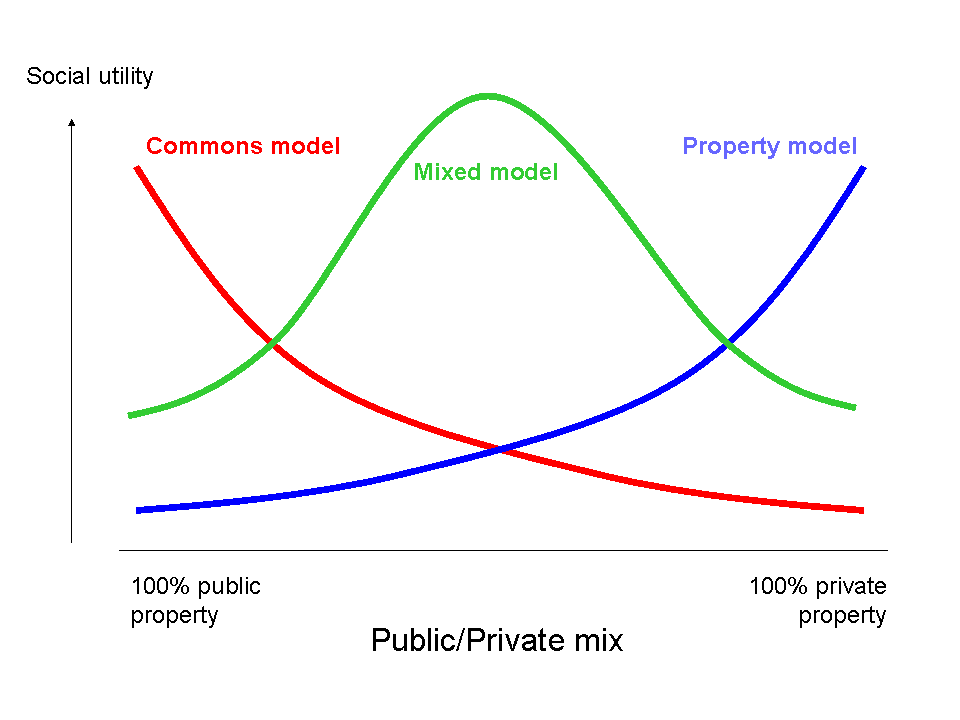
Debates about spectrum allocation or intellectual property often appear to demand a choice between private and public ownership. There are zealots on both sides: see e.g. IPcentral and Public Knowledge. Each side argues that its preferred ownership method yields the highest social utility.
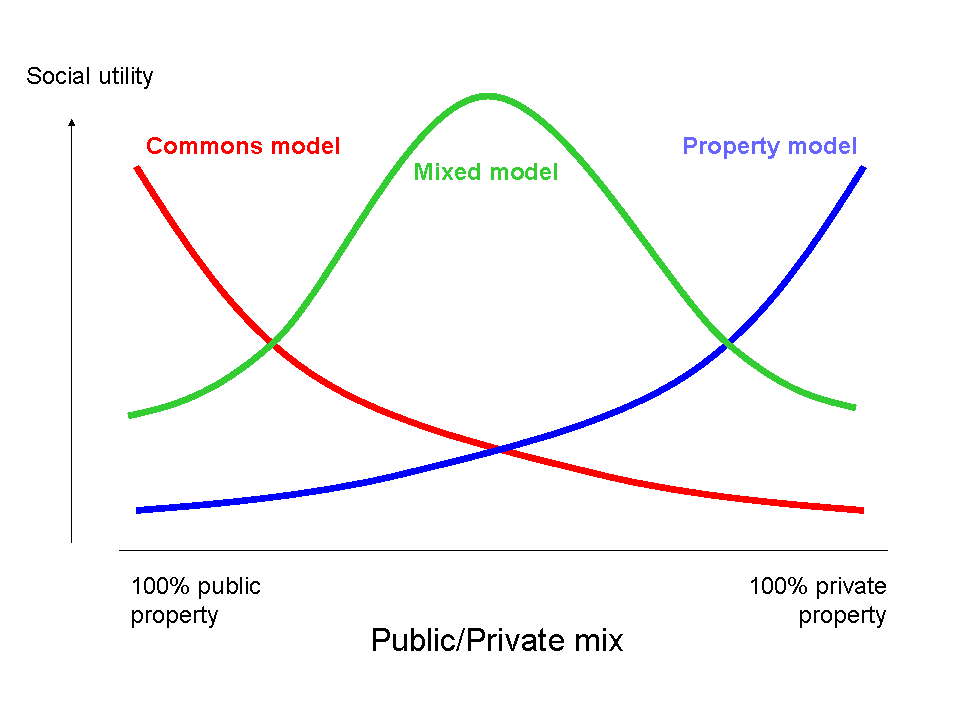
I believe that the truth lies in between. It’s more than simply a balance between property and commons; a mixture of the two yields more value than each of them individually. It’s not a question of balance and trade-offs; it’s a matter of synergy and mutual benefit.
Tren Griffin got me thinking about this in the context of spectrum allocation by citing the Central Park example. Central Park in New York City is an incredibly valuable piece of real estate; the nominal land value is astronomical, and the social utility is unquestioned. Its monetary value is due to the valuations of the surrounding apartments – but those apartments are valuable in part because they front on the Park. The combination of park and property is worth more than either all-park, or all-property. I suspect one can make a reasonably robust economic case that a mix licensed and unlicensed spectrum allocations will show the same kind of “mix maximization”.
A similar approach can be applied in other policy areas. Intellectual goods immediately come to mind. Intellectual property can encourage innovation since inventors can be assured of a return, but their creativity is built on a large public domain. Without the public domain there would be less innovation, and what did occur would be more expensive. Conversely, without investment in (temporarily) owned intellectual goods, the public domain would stagnate.
The diagram above represents the argument I’m making. I believe the “synergy” model has a higher maximum than either of the purist’s models, though I don’t know what the shape of the curve is. The economics challenge is to develop models that can handle private and public property on an apples-to-apples basis, and that can represent the mutual value add.
I’ve started thinking about brain-dead models of these phenomena to explore how one might represent the value curves and interactions. Different interaction models will lead to different curve shapes. The goal, of course, is to see if modeling can inform the optimal mix percentage. If there’s a sharp maximum, that would easy to decide; on the other hand, a relatively flat value curve (ie a situation where utility doesn’t depend strongly on the mix of ownership models) would lead to endless argument.
Saturday, November 05, 2005
Adam Smith on journalists vs. blogs and wikis
"Their delightful art is practised by so many rich people for amusement, that little advantage is to be made by those who practise it for profit; because the persons who should naturally be their best customers supply themselves with all their most precious productions. "
Smith is discussing the different levels of rent that one can extract from different kinds of land. He argues here that even though producing vegetables requires quite a lot of skill, other circumstances conspire to reduce the profit from it substantially. The same seems to me to apply to many emerging productive activities where "hobbyists" compete with professionals, e.g. wikinews.
Here's the quote in context:
"In a hop garden, a fruit garden, a kitchen garden, both the rent of the landlord, and the profit of the farmer, are generally greater than in a corn or grass field. But to bring the ground into this condition requires more expense. Hence a greater rent becomes due to the landlord. It requires, too, a more attentive and skilful management. Hence a greater profit becomes due to the farmer. The crop too, at least in the hop and fruit garden, is more precarious. Its price, therefore, besides compensating all occasional losses, must afford something like the profit of insurance. The circumstances of gardeners, generally mean, and always moderate, may satisfy us that their great ingenuity is not commonly over-recompensed. In a hop garden, a fruit garden, a kitchen garden, both the rent of the landlord, and the profit of the farmer, are generally greater than in a corn or grass field. But to bring the ground into this condition requires more expense. Hence a greater rent becomes due to the landlord. It requires, too, a more attentive and skilful management. Hence a greater profit becomes due to the farmer. The crop too, at least in the hop and fruit garden, is more precarious. Its price, therefore, besides compensating all occasional losses, must afford something like the profit of insurance. The circumstances of gardeners, generally mean, and always moderate, may satisfy us that their great ingenuity is not commonly over-recompensed. Their delightful art is practised by so many rich people for amusement, that little advantage is to be made by those who practise it for profit; because the persons who should naturally be their best customers supply themselves with all their most precious productions."
-- Adam Smith, Wealth of Nations (1776), Bk I, Ch. XI, Pt. I, http://www.worldebooklibrary.com/eBooks/Renascence_Editions/wealth/wealth1.html
Thursday, November 03, 2005
Neuroscience and public policy

It’s hard to get one’s mind around abstractions. It is particularly tricky with those ideas that don’t have good equivalents in the physical world. Such concepts, like how to treat digital knowledge, are now at the heart of our culture. Our inability to think about them intuitively means that politicians, citizens and business people have the wrong instincts when trying to solve the problems associated with them.
Lakoff and others argue that we can only understand things to the extent that we can model them on what we can do with out bodies. Here’s an excerpt from New Scientist:
“George Lakoff, a cognitive linguist at the University of California, Berkeley, believes we can only understand infinity based on what we can do with our bodies. More specifically, he says we deal with the headache of infinity by drawing on our familiarity with repetitive and iterative motions - walking, jumping and breathing, for example.”
“We use similarly physical metaphors when discussing abstract concepts such as economic policy: phrases such as "France fell into a recession" or "India is stumbling in its efforts to liberalise", for example. So if our minds grasp abstract concepts of economics in terms of what our bodies can experience, are our bodies also the way we can understand the infinite?”
“Lakoff, Núñez and Narayanan speculated that the structures in the brain that control body movements might also be used to handle all abstract concepts.”
I would love to see experiments that present subjects with mental challenges that have lesser or greater physical analogs to see how the brain deals with them. I suspect that some business, policy or life questions are intrinsically harder to think about than others, and experiement should help us to predict where to be most wary of our innate cognitive inadequacies. There is already a great deal of knowledge about the human failings in making business judgments described by the field of behavioural economics.
I believe intellectual property is one such intrinsically difficult topic, because sharing it doesn’t diminish ownershihp; in economic terms, it’s ‘non-rival’. Digital media have brought us to the point where intellectual property is free of physical wrappers, and their non-rival nature is unavoidable. I suspect that non-rivalrousness is deeply unintuitive because the physically world is intrinsically rival; our bodily metaphors, and thus our ability to think according to Lakoff et al., fail us.
Many of the anguished expectations that activists have about how digital media should behave are associated with the attributes of physical objects: “I’ve bought that album on a vinyl record, the music came off this record, therefore I own the music in the same way I own the record; I bought this album from iTunes, it’s music just like the earlier stuff, I should own it the same way I owned the vinyl record.”
More generally, I suspect our brains have difficulty with the notions of contract, particularly when the objects being traded aren’t physical. A license (“a bundle of rights and obligations between people with regard to things”) is much harder to think about, for me at least, than a trade of physical goods. Problems arise when metaphors are extended beyond their physical basis. In a recent paper, Hatfield and Weiser argue that applying a property rights model to wireless spectrum is much harder than commonly supposed.
I don’t believe the problem lies with abstractions. There are many intangible things that have normal rival properties, like shares in a company or the value of a brand. We are evidently able to think about abstractions like number and money. However, goods that are inexhaustible and infinitely copiable (like software) present problems because they don’t have physical correlates.
There are many things I find hard to grok, but that may just be me; we need experiments to see if any of these difficulties are intrinsic to human nature. Some concepts whose difficulty may be quantifiable by observation:
- Non-linearity, that is, our inability to grasp the properties of non-linear growth (e.g. the fabled reward requested by the inventor of chess, and Kurzweil passim)
- Physical interpretations of quantum mechanics, eg the “action at a distance” of the EPR paradox
- The gains of trade, which arise from the knowledge that one can trade with another
Tuesday, November 01, 2005
Guest post: Changing standards of morality
My post about scientific ideas which might be obsolete in 50 years led S. to speculate on which actions or activities that we now consider moral (i.e., positively good) could be considered immoral in the future.
Here are her comments:
Many of the actions of 19th-century America fell into this category. The first that comes into mind is the cultivation of the wilderness. Slavery was a very minor issue in the Texian revolution against Mexico. Apparently many Americans, even in the non-slave states, considered that slavery was necessary for productive use of Texas, and that this admitted evil was less than the evil of leaving the land fallow. A recent echo of this world-view was the pro-Zionist argument from my elementary-school days: that the Israelis made better use of the land, "making the desert bloom", so they should have it. (Aside: I was not convinced by this. I doubt it was my own independent thought, but rather that in New Zealand, which was underdeveloped and liked it that way, the argument didn't ring true to my teachers.).
A second is the carting off of the American Indians to boarding schools, punishing them for speaking their own language, etc.... (Aside: I imagine we [English] would have punished Gaelic and Welsh speakers in British schools at the same time if we had got around to it.) I tend to believe that the main impulse from which this action was drawn was the desire to give the children a better life in a better civilization. The judgment that one civilization is better than another has gone from universal and unapologetic to partial and often apologetic. I suppose that I hope that eventually it will be commonplace to consider all cultures different but equal, because I hope that in the future the only ghastly places will be in history. If those who attempted to civilize ghastly, or even lesser, places are then condemned, it is probably a small (although sad) price to pay.
A third, older one, is the mortification of the flesh. Often when I luxuriate in my warm and exactly soft-enough bed, I wonder to what extent that sensation would have been counted as - if not exactly evil - at least an unworthy fleshly distraction (as in "the world, the flesh, and the devil"). People now wreck their bodies to become thin, to become athletes, or through overindulgence: you would be sent straight to a psychiatrist if you wanted to wreck your body for the glory of God. (The punishment of heretics to save their souls is obviously related).
Looking at the three activities, I notice that they are all rather hard work, and related to achieving a state of perfection that we no longer believe in. I can therefore hope that working too hard and eating too healthily will be equally frowned on in the future, and that for true and timeless morality I should relax my standards in those areas.
Here are her comments:
Many of the actions of 19th-century America fell into this category. The first that comes into mind is the cultivation of the wilderness. Slavery was a very minor issue in the Texian revolution against Mexico. Apparently many Americans, even in the non-slave states, considered that slavery was necessary for productive use of Texas, and that this admitted evil was less than the evil of leaving the land fallow. A recent echo of this world-view was the pro-Zionist argument from my elementary-school days: that the Israelis made better use of the land, "making the desert bloom", so they should have it. (Aside: I was not convinced by this. I doubt it was my own independent thought, but rather that in New Zealand, which was underdeveloped and liked it that way, the argument didn't ring true to my teachers.).
A second is the carting off of the American Indians to boarding schools, punishing them for speaking their own language, etc.... (Aside: I imagine we [English] would have punished Gaelic and Welsh speakers in British schools at the same time if we had got around to it.) I tend to believe that the main impulse from which this action was drawn was the desire to give the children a better life in a better civilization. The judgment that one civilization is better than another has gone from universal and unapologetic to partial and often apologetic. I suppose that I hope that eventually it will be commonplace to consider all cultures different but equal, because I hope that in the future the only ghastly places will be in history. If those who attempted to civilize ghastly, or even lesser, places are then condemned, it is probably a small (although sad) price to pay.
A third, older one, is the mortification of the flesh. Often when I luxuriate in my warm and exactly soft-enough bed, I wonder to what extent that sensation would have been counted as - if not exactly evil - at least an unworthy fleshly distraction (as in "the world, the flesh, and the devil"). People now wreck their bodies to become thin, to become athletes, or through overindulgence: you would be sent straight to a psychiatrist if you wanted to wreck your body for the glory of God. (The punishment of heretics to save their souls is obviously related).
Looking at the three activities, I notice that they are all rather hard work, and related to achieving a state of perfection that we no longer believe in. I can therefore hope that working too hard and eating too healthily will be equally frowned on in the future, and that for true and timeless morality I should relax my standards in those areas.
Sunday, October 30, 2005
Catching a tiger by the tail: Patents could destroy the software business

The software business is working itself into a situation where its economics are built on software patents. This will be catastrophic for investors unless such patents are constrained to be of high quality, limited scope and – especially – short duration. If this doesn't happen, licensing costs will dominate the business, and pure software companies will be at the mercy of patent trolls.
The drive to software patents is based on the argument that a knowledge-based industry needs a way to trade knowledge, and thus needs intellectual property. David Kaefer of Microsoft says it well: “Software is built on the shoulders of giants -- no one can build the whole thing. Patents are a property right that allows the innovation to be exchanged”. [1]
This logic is built on the fallacy that the commodities to be traded behave just like the physical goods we’re used to buying and selling. Our models of trade are based on exchanging goods and human services that are exhaustible and rivalrous, because they are essentially tangible. If you give me $20 for the service of cleaning your gutters, you no longer own the money; and I can only clean one client’s gutters at a time. Innovations are knowledge goods. Your use of my idea doesn’t limit another person’s ability to use it, and that idea is infinitely duplicatable. George Bernard Shaw summed it up well:
If you have an apple and I have an apple and we exchange these apples then you
and I will still each have one apple. But if you have an idea and I have an idea
and we exchange these ideas, then each of us will have two ideas.
One may object that the patent system has worked well for centuries; what’s suddenly the problem? Patents have always been on innovations, and thus we have a system that works for non-rivalrous intangibles. What’s changed is that software goods are not wrapped in matter, and it’s matter which is at the root of the metaphor of trade and exchange on which our economy is based. Software is pure ideas, and can be exchanged without being wrapped in stuff. Further, there are far fewer limits on the number of ideas that can be added together than on the number of components that can be added together to make a physical product [2]. I would predict that the number of patents per product increases as the knowledge content of the product increases; there are many more patents entailed in a $100 copy of Windows than in a $100 food processor.
Software is cumulative, as the Y2K experience has shown. Most software products beyond their first release are not only built on relatively ancient algorithms, but in fact are accreted the ancient code that implements those algorithms. Advancing the product is a additive process; little is taken away once it is written. Contrast that with physical products: a new and improved kind of soap can be patented, but one doesn’t have to license all the preceding patents in order to produce the new one. [3]
One of the assumptions implicit in the industry’s world view, and explicit in David Keafer’s contention, is that companies will cross-license with each other to obtain the knowledge inputs that they require without paying for it. This has clearly worked to date; in most industries the participants create license pools or build a web of cross-licenses that enable them all to operate. In the brave new world of knowledge goods, though, everybody is a software company. It will be impossible to draw boundaries around the industry players who’ll need to cross-license with each other, since everybody will be producing software innovations, though most will not sell software. Companies that focus on selling software will be worse off than anyone else – they will have to cross-license with everybody else.
Much has been written about “patent trolls”, those companies who live to invent, and who license their patents to productizers. There are fears that the trolls will extract fearsome tolls from those who want to build products. Their disproportionate power is a consequence of the disproportionate weight that has been given to the inventive step in innovation.
Many in the software industry argue that patents are necessary to guarantee investment in innovation. This only follows if patents incent the most critical step in the process. Let’s unpack the term “innovation”. It consists of the sequential steps of invention, synthesis, execution and distribution, that is, (1) coming up with an idea; (2) composing a number of ideas into a novel product concept; (3) building the product; and (4) putting the product successfully into the market. Patents reward Step 1; however, most of the value is generated further down the chain, in synthesis, execution and distribution. Some might describe patents as the keystone that hold together the arch of innovation. I think that exaggerates the importance of invention. Patents privilege a necessary but by no means sufficient step in the process of bringing new products to market.
If hundreds or thousands of ideas have to be licensed in order to ship a new software release, pure software companies will find that their input costs balloon, especially if the licensors are in industries unrelated or hostile to them, and if inventors are able to charge prices out of proportion to the importance of inventions in the innovation process.
Still: to the extent that patents can be used to anchor innovation transactions, they are useful. However, they are scaffolding rather than a keystone. They can be removed once the structure is complete. Hence, short patent terms are essential. The term of a patent should bear some relation to the rate of change in an industry; the software industry advances rapidly. Short terms are particularly important in software, where the development of a product is cumulative. By all means allow innovators to protect the new icing which makes their cake special; but allow the lower layers to pass into the public domain so that others can also innovate in making icing.
-----------
[1] The arms race, Economist, Survey of patents and technology, 22 Oct 2005
[2] There are surely limits to size of a given piece of software, as innumerable software projects who’ve missed their deadlines have demonstrated; Microsoft’s difficulties in shipping the Longhorn release of Windows is one in a long line of examples.
[3] For example, Lever 2000 bar soap is covered by patents 4,695,395 and 4,663,070.
Friday, October 28, 2005
Science today, gone tomorrow
Christopher Ireland asked me a wonderful question a few days ago: “Of all the facts and principles that science currently believes to be true, which do you think are most likely to be disproved in the next 50-100 years?”
There is more up for grabs in the sciences than some people might think. Christopher explains why this matters:
Brain function. There's a lot of work going on here, and it's amazing how little we know. fMRI data is just beginning to be integrated with static imaging, and the scale of analysis is large - patches of brain tissue centimeters across. As the resolution improves, a lot of old ideas will have to be thrown out; they may improve the standard "functional areas" analysis of where how information processing happens.
Cosmology. The standard model of cosmology is creaking, but nobody really knows what to replace it with. "Dark matter" is a symptom; it's essentially a fudge factor in the model invented to make the the universe expand at observed rates. I suspect we'll also see some change in more mundane fields like stellar and galactic models; they're constantly being stressed by new data. The Big Bang model could be discredited in a lot less than fifty years. Who knows, some people are even muttering that Newtonian mechanics is incorrect.
Climate chemistry. There's so much attention here, and there are so many layers of analysis involved (that is, from molecular chemistry to bulk transport at the order of kilometers), that I expect "facts" greenhouse mechanisms to be restated. It wouldn't surprise me at all if other chemicals beyond CO2 and methane turn out to be critical in global warming. I'm not saying that global warming will be found to be incorrect, just that the mechanisms we now assume to be true could well wrong.
Geology. Plate tectonics has stood the test of time but increasingly fine-grained new data could undermine the heuristics that are used to explain earthquakes. We know so little about the dynamics of the mantle, let alone the core, that we might have a very different view of crust activity in a hundred years.
Materials science. This is another multi-scale field, like climate. There is a lot that's not understood between the Angstrom scale of atoms, the nanoscale of new materials, and bulk behavior. It's not been a fashionable field, but it's quite possible that some basic rules of thumb, eg in tribology, will come to be rewritten.
Biological classification. We know almost nothing about bacteria, relative to their importance. For example, the human gut houses 10 to 100 trillion microbes from 500 to 1000 species - more than 10 times the number of cells that make up the human body. The current three domain classification of life (eukaryotes, bacteria and archaea) could well turn out to be wrong.
S., who’s a lapsed physicist just like me, adds these thoughts:
Nutrition - or, more generally, "how to be a fit person". The constant discovery of new trace substances (aspirin, omega-3s, etc.) that you need to be truly healthy suggests the kind of explosion of epicycles that precedes a paradigm shift. I anticipate the discovery that there are multiple different models of a healthy lifestyle, and the "eat fruit and vegetables and lean meat, drink exactly 4oz of red wine a day, and exercise 90 minutes a day" is only one of these. Your model may be a matter of choice, or may be ultimately constrained by ? gut bacteria, level of social interaction, mitochondrial DNA, level of something in the womb, aspect of Saturn at your time of conception...
Quantum mechanics - your basic Schrödinger equation. This is a bit of a cheat on my part because nobody understands it. However, there's a swirl of ideas around the arrow of time, the classical limit of quantum mechanics, and Bell's inequality crying out for a major advance. Were I cleverer, this is what I would be working on.
There is more up for grabs in the sciences than some people might think. Christopher explains why this matters:
“I'm interested because I believe social behaviors are strongly influenced byHere are my guesses:
our collective scientific beliefs. There's a lag time (a long one) while the
science filters down to the population, but once it becomes part of people's
general sense of reality, it changes their behavior in subtle, but pervasive
ways.”
Brain function. There's a lot of work going on here, and it's amazing how little we know. fMRI data is just beginning to be integrated with static imaging, and the scale of analysis is large - patches of brain tissue centimeters across. As the resolution improves, a lot of old ideas will have to be thrown out; they may improve the standard "functional areas" analysis of where how information processing happens.
Cosmology. The standard model of cosmology is creaking, but nobody really knows what to replace it with. "Dark matter" is a symptom; it's essentially a fudge factor in the model invented to make the the universe expand at observed rates. I suspect we'll also see some change in more mundane fields like stellar and galactic models; they're constantly being stressed by new data. The Big Bang model could be discredited in a lot less than fifty years. Who knows, some people are even muttering that Newtonian mechanics is incorrect.
Climate chemistry. There's so much attention here, and there are so many layers of analysis involved (that is, from molecular chemistry to bulk transport at the order of kilometers), that I expect "facts" greenhouse mechanisms to be restated. It wouldn't surprise me at all if other chemicals beyond CO2 and methane turn out to be critical in global warming. I'm not saying that global warming will be found to be incorrect, just that the mechanisms we now assume to be true could well wrong.
Geology. Plate tectonics has stood the test of time but increasingly fine-grained new data could undermine the heuristics that are used to explain earthquakes. We know so little about the dynamics of the mantle, let alone the core, that we might have a very different view of crust activity in a hundred years.
Materials science. This is another multi-scale field, like climate. There is a lot that's not understood between the Angstrom scale of atoms, the nanoscale of new materials, and bulk behavior. It's not been a fashionable field, but it's quite possible that some basic rules of thumb, eg in tribology, will come to be rewritten.
Biological classification. We know almost nothing about bacteria, relative to their importance. For example, the human gut houses 10 to 100 trillion microbes from 500 to 1000 species - more than 10 times the number of cells that make up the human body. The current three domain classification of life (eukaryotes, bacteria and archaea) could well turn out to be wrong.
S., who’s a lapsed physicist just like me, adds these thoughts:
Nutrition - or, more generally, "how to be a fit person". The constant discovery of new trace substances (aspirin, omega-3s, etc.) that you need to be truly healthy suggests the kind of explosion of epicycles that precedes a paradigm shift. I anticipate the discovery that there are multiple different models of a healthy lifestyle, and the "eat fruit and vegetables and lean meat, drink exactly 4oz of red wine a day, and exercise 90 minutes a day" is only one of these. Your model may be a matter of choice, or may be ultimately constrained by ? gut bacteria, level of social interaction, mitochondrial DNA, level of something in the womb, aspect of Saturn at your time of conception...
Quantum mechanics - your basic Schrödinger equation. This is a bit of a cheat on my part because nobody understands it. However, there's a swirl of ideas around the arrow of time, the classical limit of quantum mechanics, and Bell's inequality crying out for a major advance. Were I cleverer, this is what I would be working on.
Tuesday, October 25, 2005
Avoiding Armageddon – Why content companies will turn against Intellectual Property

While the two sides in the intellectual property rights debate often argue at cross purposes, or fulminate about secondary issues [1], they are divided on a fundamental issue: whether scarcity of knowledge goods is desirable or not. The “oligarchs” [2] believe that without scarcity they cannot make money, and that without money there is no incentive to create new knowledge. The “anarchists” believe that culture can only flourish if knowledge is abundant and freely available; innovation doesn’t need incentives, just the oxygen of other ideas.
The oligarchs are winning against the anarchists, and they’re set on the path of “propertization” of all useful knowledge. Rather than being good for their businesses, I believe it will prove catastrophic.
Both sides believe that the growth of knowledge is essential to human well-being. However, the oligarchs rank economics ahead of culture, and the anarchists do the reverse. Their fortified debating positions remind me of nothing as much as Industrialists vs. Environmentalists. The argument about knowledge can be turned on its head, just as Hawken/Lovins [3] and McDonough/Braungart [4] did for the environment by arguing that sustainability was good business.
The oligarchs (or King Content, if you like) seem to believe that information is property which needs to be locked down with DRM in order to have a sustainable economy. They are willing to pay the price of buying all their knowledge inputs in order to achieve this [5]. I don’t believe this makes sense for knowledge goods; unlike physical property, knowledge doesn’t (always) degrade over time, and its price does not decline. Since knowledge is so hard to measure, and since the physical attributes of goods have to date been a viable proxy for their knowledge content, economists have been able to ignore the overwhelming scale of knowledge content in our economy. If it is all turn into traditional property, businesses will find themselves hamstrung beyond imagination.
A substantial knowledge commons may be useful to the anarchists/copyfighters; however, it will be essential to the oligarchs [6]. Once this is realized, content companies will be bigger champions of Fair Use than copyfighters. I'm not arguing that they will swear off the concept of intellectual property, but that they will not follow the logic of "all property is the same" to its ultimate point. (Yes, I know, the title of this post was misleading - but it got you to read this far, didn't it? Sorry.)
Conversely, content anarchists will find themselves demanding protection of their cultural production, and working hard to prevent its incorporation into commercial products. It’s a replay of the “Keep My Software” philosophy that led to the GPL, and one can see it at work in the Share Alike condition in the Creative Commons license. Who knows, some may even learn to Stop Worrying and Love DRM.
After all the dust has settled, we’ll find the players at the opposite sides of the argument from where they began – or, perhaps more hopefully, peacefully coexisting in the middle ground.
----------
[1] Side issues include content companies insisting on total control over all content and all decoding tools at all times, and activists insisting (in an amusingly conservative way) that new content should play anywhere on any of their devices in any way they like, just like the old stuff did. I believe this is secondary because it is an argument over product features, which will evolve as the market matures.
[2] Siva Vaidhyanathan introduced the oligarch/anarchist antithesis in his book The Anarchist in the Library: How the Clash Between Freedom and Control is Hacking the Real World and Crashing the System (2004). His definitions: “Anarchy is a governing system that eschews authority. Oligarchy governs form, through and for authorities.” Most of the players in the debate are neither anarchists nor oligarchs in the strict sense, but they do shade towards the two ends of the spectrum. I believe the distinction is useful starting point, but there are never really only two sides in an argument. Vaidhyanathan argues, rightly I believe, that “[the] question for us in the twenty-first century should not be choosing anarchy or oligarchy but constructing and maintaining systems that discourage both”.
[3] Natural Capitalism: Creating the Next Industrial Revolution (2000) by Paul Hawken, Amory Lovins, L. Hunter Lovins
[4] Cradle to Cradle: Remaking the Way We Make Things (2002) by William McDonough, Michael Braungart
[5] Even a staunch copyfighter like Yochai Benkler has argued that increased property rights will advantage content owners over non-market actors; see his paper The Commons as A Neglected Factor of Information Policy at the 26th Annual Telecommunications Research Conference, Oct. 3-5, 1998. I’m claiming (but have not demonstrated) that his conclusion is based on an under-estimate of the cost of purchasing information inputs. A related threat to content companies is the “patent blackmailer” – small companies that exist merely to develop and patent inventions which they then sell to larger players at a suitably (in)opportune moment.
[6] I will argue in another post that a mix of public and private property increases the value of both.
Friday, October 21, 2005
Peak Oil meets Global Broadband
The Peak Oil theory holds that global oil production will peak soon, and that as production declines, energy prices will increase rapidly. This will lead to major social disruption, including radically more expensive transportation. Let’s stipulate for the purposes of this scenario exercise that the Peak Oil proponents are right.
Activities that require moving physical objects around will be hurt. Shipping a product directly to you from China in a retail FedEx package will be much more expensive than buying a locally produced good. Suburbia, which is premised on cheap gasoline, will crumble, and flying across the country for Thanksgiving will be a thing of the past.
On the other hand, moving information will be essentially free thanks to global broadband networks. The stuff of knowledge work will move easily: phone calls to tech support, medical x-rays, software that needs to be rewritten, contracts to be drawn up and reviewed, and so on.
Our sense of space will be warped: relatively speaking, distances crossed by bits will shrink, and distances crossed by atoms will grow.
This scenario exercise is more than just a good topic for a term paper. It highlights the different dynamics of the two scarcities that lie at the heart of a knowledge economy: energy and brain power.
One implication is “Move, then customize”. Materials will be moved in bulk, ie cheaply, and tailored to the customer as close to them as possible. Micro-manufacturing will become common, and matched to local power generation from non-fossil energy sources. People will keep devices a long time, but upgrade the software often.
There will be marked physical differences between communities, as they produce and consume tangible goods locally. You’ll be able to recognize where someone’s from by how they dress. On the other hand, entertainment and convictions will move more freely where they’re not constrained by local conditions. Expect more culture wars about abstract notions like intellectual property rights and freedom of expression.
Knowledge processing can be easily off-shored, but not the production and manipulation of stuff. Since humans need physical proximity for creativity, places where many brains can be concentrated will have an advantage: Beijing, Bangalore, and the Bay Area, for example.
Second tier cities will suffer, since their best-paying jobs will be knowledge work that will be undercut by off-shoring. For example, Washington State has forecast the occupations with the fastest annual growth rate in the period 2002-2012. Here they are in order of decreasing income (estimated average wages indicated at some inflection points):
Activities that require moving physical objects around will be hurt. Shipping a product directly to you from China in a retail FedEx package will be much more expensive than buying a locally produced good. Suburbia, which is premised on cheap gasoline, will crumble, and flying across the country for Thanksgiving will be a thing of the past.
On the other hand, moving information will be essentially free thanks to global broadband networks. The stuff of knowledge work will move easily: phone calls to tech support, medical x-rays, software that needs to be rewritten, contracts to be drawn up and reviewed, and so on.
Our sense of space will be warped: relatively speaking, distances crossed by bits will shrink, and distances crossed by atoms will grow.
This scenario exercise is more than just a good topic for a term paper. It highlights the different dynamics of the two scarcities that lie at the heart of a knowledge economy: energy and brain power.
One implication is “Move, then customize”. Materials will be moved in bulk, ie cheaply, and tailored to the customer as close to them as possible. Micro-manufacturing will become common, and matched to local power generation from non-fossil energy sources. People will keep devices a long time, but upgrade the software often.
There will be marked physical differences between communities, as they produce and consume tangible goods locally. You’ll be able to recognize where someone’s from by how they dress. On the other hand, entertainment and convictions will move more freely where they’re not constrained by local conditions. Expect more culture wars about abstract notions like intellectual property rights and freedom of expression.
Knowledge processing can be easily off-shored, but not the production and manipulation of stuff. Since humans need physical proximity for creativity, places where many brains can be concentrated will have an advantage: Beijing, Bangalore, and the Bay Area, for example.
Second tier cities will suffer, since their best-paying jobs will be knowledge work that will be undercut by off-shoring. For example, Washington State has forecast the occupations with the fastest annual growth rate in the period 2002-2012. Here they are in order of decreasing income (estimated average wages indicated at some inflection points):
Lawyers ($100k)Note that the top four are knowledge jobs which could relatively easily be provided at a distance. The jobs that aren’t subject to out-of-region competition are the low-income ones at the bottom of the list.
Computer Software Engineers, Systems Software
Computer Software Engineers, Applications
Computer Programmers
Registered Nurses ($60k)
Computer Support Specialists
Carpenters
Construction Laborers ($35k)
Dental Assistants
Hairdressers, Hairstylists, and Cosmetologists
Security Guards
Landscaping and Groundskeeping Workers ($25k)
Receptionists and Information Clerks
Janitors and Cleaners, Except
Maids and Housekeeping Cleaners
Laborers and Freight, Stock, and Material Movers, Hand ($24k)
Wednesday, October 19, 2005
Ten steps to saving the planet
I don't normally simply link to news stories, but Dave Reay's "Your Top Ten ways to take on global warming" in the New Scientist (10 Sep 05) is so good that it deserves mention.
In case the story had been archived behind the subscription wall by the time you click on the link, here's the list in short:
In case the story had been archived behind the subscription wall by the time you click on the link, here's the list in short:
- Dress for the weather
- Get out of the car
- Get into composting
- Fly less, especially short haul
- Change your driving habits - or better still, your car
- Remember the appliance of science
- Avoid flatulent and jet-setting food
- Learn the 3 Rs
- Improve your ethics at work
- Go green at the final checkout
Getting their priorities right
 To alleviate some the unrelieved seriousness of recent posts, here's news from Europe courtesy of New Scientist:
"A beer mat that knows when a glass is nearly empty and automatically asks for a refill has been created by thirsty researchers in Germany.
"Andreas Butz at the University of Munich and Michael Schmitz from Saarland University came up with the idea while out drinking with their students."
I somehow can't imagine this happening in the research universities of the Puritan States of America.
More from CNN.
Monday, October 17, 2005
Money? No thanks!
Matt Marshall reports on start-ups that don't need VC money:
The traditionally cited "factors of production" are land, labor, and capital (and coordination/entrepreneurship, some say). It's clear that in the case of software, know-how matters more than any of those. One might say that the ability to innovate derives from "human capital", that is, education and training. I'm not yet convinced, since neither the inventive urge nor the common knowledge context in the Internet community has the properties of physical capital. Regardless: the assets needed for knowledge production are scant, and this puts in question the role of providers of such assets.
There is often too much money chasing too few deals in the VC world; as more businesses are primarily knowledge-based, this problem will get worse. The key resource entrepreneurs require will increasingly be just social, not financial, capital; they always needed it in the past, but VCs were able to package it in money and make a $$ return for their investors. This is a case where knowledge is losing its husk of money; I argued in Why you should care about CPCM that digital media are a case where information has lost its husk of matter.
The obverse point is that the barriers to entry are very low. If a newbie and three friends can take customers away from a market leader after four months' work, someone else can do the same to them. If the products are intangible, churn will be great. The barrier to entry will be as intangible as the threat. Brand will matter: the loyalty and trust that users have in a provider who buffers them from too much change.
"Many Internet entrepreneurs don't need the cash, because they're buildingSugarCRM took the money anyway, because one of their VCs had invested in Salesforce.com, and they needed his connections. It worked, it seems; the CEO claims that ten companies have switched away from Salesforce.com. In this case, VC stood for "Venture Connections".
products cheaply — using open Web technologies, often with two or three developers. "
"SugarCRM's software was done dirt cheap. Roberts and his small team worked out of their homes, chatted through the night via computer on Yahoo!'s Instant Messenger and met only once a week at a small borrowed office. Within four months, they had launched a test version and had 1,000 people downloading the software."
The traditionally cited "factors of production" are land, labor, and capital (and coordination/entrepreneurship, some say). It's clear that in the case of software, know-how matters more than any of those. One might say that the ability to innovate derives from "human capital", that is, education and training. I'm not yet convinced, since neither the inventive urge nor the common knowledge context in the Internet community has the properties of physical capital. Regardless: the assets needed for knowledge production are scant, and this puts in question the role of providers of such assets.
There is often too much money chasing too few deals in the VC world; as more businesses are primarily knowledge-based, this problem will get worse. The key resource entrepreneurs require will increasingly be just social, not financial, capital; they always needed it in the past, but VCs were able to package it in money and make a $$ return for their investors. This is a case where knowledge is losing its husk of money; I argued in Why you should care about CPCM that digital media are a case where information has lost its husk of matter.
The obverse point is that the barriers to entry are very low. If a newbie and three friends can take customers away from a market leader after four months' work, someone else can do the same to them. If the products are intangible, churn will be great. The barrier to entry will be as intangible as the threat. Brand will matter: the loyalty and trust that users have in a provider who buffers them from too much change.
Sunday, October 16, 2005
Brain Fitness Clubs

For a society that runs on intellect - this is the Information Age, they tell us, and We're All Knowledge Workers Now - it's curious that Brain Fitness Clubs haven't swept the nation. Honing and toning the body is a perennial fashion phenomenon. Yoga is big this year; last year it was Tae Bo. Beautiful Minds only apply to crazy economists, but everybody aspires to a Beautiful Body.
It's medically accepted that "use it or lose it" applies to the mind as well as the body. A regular program of training would improve mental performance just as it helps with physical well-being. It's easy to imagine an Oprah-ready offering; one can re-use all the tricks that health clubs have developed, like fitness assessments, group work-outs, personal trainers, expensive equipment, and a range of activities tailored to every taste. (There won't be much of a market for spandex accessories, though, and the top practitioners won't be very telegenic.) All it needs is a charismatic entrepreneur who's smart, sexy and a super-seller.
Mental fitness is already established in geriatrics, where Early Boomers buy what it takes to stave off the debilities, mental as well as physical, of old age. Cognitive training can reverse cognitive impairment in many seniors.
The mystery is why it hasn't shown up in the mainstream. Perhaps people feel that their work gives them enough mental exercise, and that they couldn't bear to do any more. However, in the days of farm labor, workers would turn to sport over the week-end and dances in the evenings.
Perhaps it's the association with school. Most people hated school, and mental training sounds too much like being back in class.
Perhaps its the belief that one doesn't need to learn how to think. We all know how to think, just like we know how to breathe and walk; we don't need classes on how to walk around, do we? (Actually, we do; cf. the Alexander Technique.) Sure, occasionally we need some one-off training in a new technique, but after that it's just application - right?
Western disinterest in regular training and study with a teacher of one's craft has always perplexed me. It is taken for granted in many Eastern traditions, whether in martial arts (the craft of killing people) or meditation (the craft of cultivating the mind).
Last but not least, it could be that the term "mental health" in fact connotes mental illness with all the stigmas that entails, whereas "physical health" is something that's a good in itself.
Currently, mental fitness is either a private, personal activity (crossword puzzles, sudoku) or a social one grounded in the humanities (book clubs, philosophical discussions).
However, outsourcing and offshoring are rubbing American noses in the prospect of being put out of their job by smart young aliens. It won't be long before a canny entrepreneur figures out how to franchise getting yourself a supple and sexy mind. Some elements of the offering:
- Meditation to increase concentration and creativity
- Memory training and competitions
- Strategy games - remember the old guys on the sidewalk playing chess or go?
- Mind-body combo activities like combining two senses, or doing complex tasks with your non-dominant hand
- Equipment - expensive hardware to make you feel your subscription is buying something real, e.g. mind-controlled video games (overview)
- "Circuits" - a pre-planned sequence of activities from the above list
Subscribe to:
Posts (Atom)