Friday, June 30, 2006

A connectivity compromise

The effort to prevent US consumer broadband providers from charging anyone except end-users for improved quality of service has stalled in the Senate. Andrew Orlowski skewers the paranoia of the Neutralistas as only the Register can. He writes:

“Rather than confront the underlying, and very real problems it seeks to redress, the blogging wing of the US left has instead created an alternative cyber-reality - populated by phantom demons, imaginary conspiracies, and bogeymen. [...] The immediate consequence of the focus on "Neutrality" has been to permit the cable lobby to write the most anti-competitive bill for thirty years. Perhaps they knew the bloggers were only playing a game, and wouldn't think to look at the rest of the legislation.”

People may at last be in a mood for a compromise. Here’s one: wireline network operators may not block traffic but they can prioritize it, as long as any content provider can buy prioritized access on equal terms. The conditions can be lifted if true competition in consumer broadband materializes.

The situation

There is fear on both sides:

  • The content community fears that the network operators could use their market power to integrate vertically, lock out new entrants, and extract rents.

  • The operator community fears that anti-competition rules will have unintended consequences that suppress their profitability below sustainable levels.
  • One can address both sets of fears by recognizing that market power should be mitigated, while taking into account that competition in last-mile broadband would reduce the need for such actions.

    A solution: the Open Offer Internet

    I start with the premise that there is insufficient competition in last mile high speed broadband networks, and that this concentration is likely to suppress innovation and raise prices, thus decreasing consumer welfare. This situation justifies the imposition of "Open Offer" conditions on both telephone and cable companies that offer broadband access:


    1. No traffic blocking; all sites to be accessible to consumers

    2. The operator can enter into arrangements with 3rd parties to improve content delivery, but this offer should be available on reasonable and non-discriminatory terms (taking into account discounts etc.) to any comer.

    3. Operators shall interconnect with all other broadband networks on reasonable and non-discriminatory terms.

    This is not a perpetual mandate, and can change if the competitive situation improves. There would be a review every few years:

    • The FCC reports on compliance with the Open Offer terms. The FCC can get access to confidential company information to make this assessment, but may not make such information public.

    • Operators can request for Open Offer conditions on them to be lifted, if they can prove that the markets they operate in are all competitive.

    • The FCC can (re)impose Open Offer conditions on operators if they see anti-competitive behavior.

    Notes

    Operators may offer tiered service tiers to consumers if they wish.

    I don’t use the FCC definition of broadband; saying that anything faster than 200kbps is broadband is just silly. Today, “high speed broadband” effectively means speeds faster than 2 Mbps. This will always be a moving target, so it’s better to define it in relative terms. For example: define the threshold of high speed broadband as the lowest speed provided to the top 20% of homes.

    Thursday, June 29, 2006

    Useful self-delusion

    Susan Stamberg’s interview with Lawrence Summers [1] puts on view the kind of person that cannot conceive of personal failure. I don’t think he’s denying responsibility for his failure; he is simply unable to see it.

    This characteristic is so common among leaders that it’s probably a requirement for success. Such people inspire loyalty just because they always see the bright side of every situation. They can persuade others that they’re on the side of right because they believe themselves to be so. When something goes well, it must be because of their actions; when something goes wrong, it must be someone else’s fault.

    Their motivational ability follows from an inability to see their own flaws. In a sense one can’t blame them for not taking responsibility; personal failure is just not the truth as they see it.

    Jeff Skilling of Enron fame is another recent example. A Wall Street Journal article [2] reports that Skilling believed that if he just told the "real" story of Enron, he'd be in no danger. This led him to providing prosecutors with pieces of information that they effectively used against him at the trial. He didn’t believe then, and doesn’t believe now, that he committed any crimes, even though a Houston jury convicted him of 19 counts, including conspiracy, fraud and insider trading.

    The “little people” find it hypocritical when leaders insist that employees take responsibility for their actions, but then don’t hold themselves accountable. The beam in the CEO’s eye doesn’t prevent him from seeing the splinter in everyone else’s... But be gentle; how can it be hypocritical if the Chief Ego Officer truthfully doesn’t believe that they’ve done anything wrong?

    ---------

    [1] NPR Morning Edition, “Summers Looks Back at Harvard Presidency,” 29 June 2006

    [2] John Emshwiller, The Wall Street Journal, “In New Interview, Skilling Says He Hurt Case by Speaking Up,” 17 June 2006

    Wednesday, June 28, 2006

    Ephebophobia

    Outsourcing angst is due to insecurity: fear that a comfortable status quo is going to change for the worse.

    The most obvious fear is that of losing one’s job, sooner or later, because someone in Asia can do it more cheaply.

    Since the outsourcer is usually in another country, a fear of foreigners – xenophobia – rapidly creeps into the discussion. There’s more than a little “issue bleed” between the off-shoring and immigration debates.

    Since the conversation is driven by Baby Boomers, there’s also the fear of another Other: the young. The Boomers are now parents and proud grand-parents. They can’t admit to loathing their off-spring; it doesn’t fit the wholesome self-image. However, they are getting old, and the next generation is beginning to threaten their prerogatives.

    Energetic, optimistic, in the full bloom of youth: today’s Menace are the Asian ephebes.

    (Thanks to Nicholas Shum for help with the Greek.)

    Thursday, June 22, 2006

    The engineering brain

    Tren Griffin alerted me to an article by Debra Schiff in EETimes which floats some ideas that have a bearing on the Hard Intangibles problem [1]:
    1. Spatial abilities appear to be more localized in the brain than other skills, such as verbal ability.
    2. Spatial ability is a key trait for engineers, scientists and mathematicians.
    3. The brains of engineers have systemizing mechanisms that are set at a higher-than-average levels.
    As Lakoff has pointed out [2], organizational structure is conceptualized as physical structure, as in “The theory is full of holes,” “The fabric of this society is unraveling,” “His proposed plan is really tight; everything fits together very well.” Since systems are complex abstract structures, it’s plausible that we use spatial brain centers to think about systems, and that spatial talent would lead to systematizing ability.

    This raises the obvious question: Has MRI shown that engineers or high systematizers in general, have more extensive spatial manipulation centers in their brains? Listening to software engineers definitely suggests that spatial metaphors are central to their practice.

    I dream about putting a software developer in an fMRI while they’re writing code, and seeing the spatial centers in the brain lights up. And as an encore, seeing what happens when the system problem cannot be modeled in 3D space, eg “high dimensional” challenges like concurrent systems.

    -------

    [1] Debra Schiff, “What drives you? Pick your brain,” EETimes 6/19/2006 http://www.eetimes.com/showArticle.jhtml?articleID=189401732

    [2] Lakoff and Núñez (2000), Where Mathematics Comes From

    Thursday, June 15, 2006

    Brothers?

    The Diary of a Tired Black Man video clip reminded of the custom in the African-American community to describe people in one’s community as “brother” and “sister,” even if they aren’t relatives.

    Curiously, Afrikaners – those paragons of racism – used to do the same. The secret elite that ran Afrikaner culture was called the “Broederbond,” that is, the society of brothers. Afrikaners of my father’s generation (though not my father) would often call each other “broer” as a sign of solidarity.

    I’ll take as read the vast differences between these groups, such as the oppressed/oppressor distinction.

    There are a few similarities, though, that might have led to this common usage:

    • Both communities are deeply religious, with a strong Protestant strain
    • Both see themselves as threatened racial minorities in a sea of people of another color
    • Both have a folk memory of being displaced, of being strangers in their own land

    Monday, June 12, 2006

    The dreaded decline in American science

    I’m tired of the moaning about the supposed decline of American science and technology. There are frequent forecasts of doom, along with calls (by professors) for increased funding of education, and (by business people) for increased R&D subsidies.

    It doesn’t necessarily follow:

    It’s not at all proven that the US lags in science and technology; see e.g. data cited by Fareed Zakaria on page 2 of his MSNBC column “How Long Will America Lead the World?” According to him, the U.S. is currently ranked the second most competitive economy in the world (by the World Economic Forum), and is first in technology and innovation, first in technological readiness, first in company spending for research and technology and first in the quality of its research institutions.

    Even if it’s true that the US lags, it’s not proven that science/tech is the key factor in innovation. Innovation is creating a new product that makes a difference. Science and technology is necessary, but not sufficient; I’m not even convinced it’s the key factor. iPod is a great market innovation, but Apple wasn’t the inventor of the MP3 player or on-line music stores. Rather, the key was to design a compelling whole.

    Even if technology were the key factor in innovation, it’s not clear that science/tech is the US’s key competitive advantage going forward. Ricardo’s theory of comparative advantage in trade suggests that countries should focus on the activity where they’re “most better” at. If the US is better at business model innovation than engineering, then it should focus on business, even if its engineering is the best in the world.

    I’m reminded of the old story about the California gold rush: the diggers went home poor, but Levi Strauss made a fortune selling jeans. I suspect that having a science-educated workforce is the gold fever of the knowledge economy boom.

    Rising countries are strong in science and technology; but it doesn’t follow that science and technology is the source of their competitiveness. It is just as possible, and more likely, that it’s the “technology” of market capitalism, selectively applied.

    The talents required to succeed in this economy may well be soft, human skills, like those advocated by Dan Pink in his book “A Whole New Mind”. I have my doubts about it – not least because Dan Pink argues that the future belongs to people like Dan Pink – but it give a provocative counter-point to the STEM (Science, Technology, Engineering and Mathematics) advocates. Pink’s six essential aptitudes for the coming century are design, story, symphony, empathy, play, and meaning; very little along those lines is taught in engineering school.

    I hear echoes of the Manhattan Project and its successors in the battle cries of the technocrats. The supposed success of science in winning the second world war led to Robert McNamara & Co running the Vietnam war by the numbers, with such great success. Not to mention Donald Rumsfeld’s Technology Über Alles strategy for winning the war in Iraq….

    Of course we need people who can excel in knowledge-intensive jobs – but that’s not the same as STEM jobs.

    And of course we need a good supply of engineers. However, the problem (if any) is one of demand, not supply. If engineers were indeed so valuable to companies, then employers would increase salaries until all positions were filled to their satisfaction. A “Help Wanted” sign in a diner’s window doesn’t mean that there’s a shortage of short order cooks; it mostly means that the owner of the diner isn’t willing to pay a decent wage.

    I’ll concede that there is a problem with US education. (Though… when hasn’t there been? And which country doesn’t agonize over education?) The NAS panel recommended that more science teachers be recruited by paying sign-on bonuses (PDF exec summary). However, this is a palliative at best. The core problem is that teachers aren’t paid enough (blame the Right), and that the teachers’ unions have a stranglehold on workplace rules (blame the Left). There is a gap in teachers’ salaries, and a lack of accountability.

    The American Federation of Teachers salary survey reports that the average job offer in 2004 to college graduates who were not education majors was $40,472; that’s $8,768 more than a starting teacher’s salary. A sign-on bonus will help, but only if salaries for mid-career teachers also increase. At this point, there’s no financial incentive for good scientists and engineers to stay in teaching.

    Here’s one reason why school science scores are better in emerging countries: in those places, teaching is still a relatively well-paying job. The US problem of affluence will catch up with them in time. For example, India is struggling to find university lecturers in computer science, since they can earn so much more in the commercial sector. American science education will only improve if the society decides that teachers are as important as design engineers, and pays them accordingly; sadly, that’s not on the cards.

    Wednesday, June 07, 2006

    Math as Metaphor vs. Multiple Intelligences

    Jonathan Aronson alerted me to the relevance of Howard Gardner’s work on Multiple Intelligences to my “hard intangibles” project.

    Gardner argues that intelligence isn’t a one-dimensional capacity that can be measured by (say) an IQ test. He defines it as “the ability to solve problems, or to fashion products, that are valued in one or more cultural or community settings.” He argues that there are seven distinct intelligences: linguistic; logical-mathematical; spatial; musical; bodily-kinesthetic; interpersonal; and intrapersonal. Each person has a different mix of skills. [1]

    He applies this theory to education. In ref. [1] he gives the example of a child that’s having trouble learning mathematics because the principle to be learned (the content) exists only in the logical-mathematical world and it ought to be communicated through mathematics (the medium); however, the child struggles with math. A good teacher finds a way around this problem by translating the principle into another domain, e.g. through a story or a spatial model. Gardner observes that this alternative route to understanding “is at best a metaphor or translation. It is not mathematics itself. And at some point, the learner must translate back into the domain of mathematics.”

    This raises a question about Lakoff’s work [2] about the underlying sensory-motor metaphors in mathematics. If Gardner is correct that mathematics is a domain with its own intelligence, and if there’s a distinct basis for each intelligence in brain physiology, then his claim that mathematics is based on spatial and bodily-kinesthetic metaphors may be nothing more than a way to make math intelligible to people with good spatial and bodily-kinesthetic intelligence. Those who are proficient at mathematics use their “mathematical faculty”, and don’t have to fall back on sensory-motor metaphors.

    From my reading of their work, Lakoff makes a more persuasive case than Gardner, and I’m therefore inclined to doubt that spatial models in mathematics are simply crutches.

    Still – it’s notable that two of Gardner’s intelligences (logical-mathematical, and musical) do seem more remote from the sensory-social experiences of childhood, which Lakoff argues shapes our cognitive abilities, than the others. It suggests that one might expect another collaboration from Lakoff, on “Where Music Comes From”.

    ----------

    [1] Howard Gardner (1993), “Multiple Intelligences: The Theory in Practice”

    [2] George Lakoff and Rafael Núñez (2000), “Where Mathematics Comes From: How the Embodied Mind Brings Mathematics into Being”

    Monday, May 29, 2006

    If you’re so smart, why do only politicians pay attention to you?

    Politicians can’t live without economists. Every policy needs an economic rationale, and there are platoons of theoretical economists in think tanks and universities ready to opine at a moment’s notice. National well-being is measured in money, and economists are a convenient proxy for business.

    Business people do fine without economists, thank you very much. Executives work hard to avoid the dismal science and its practitioners. Economists have directed some stellar business failures, like Long-Term Capital Management. LTCM’s board included two Nobel Prize winners in economics; it folded four years after its formation with losses of $4.6 billion.

    Why is economic advice so essential in politics, but considered pointless in business?

    First, politicians have learnt that wrapping themselves in science adds to their credibility. Conveniently, economists learned the same thing when they appropriated the mathematics of classical mechanics in the 19th Century. Economists and politicians happily conspire to stage a theater of scientific decision making about the economy.

    Day-to-day business is, in fact, far more scientific than government policy making. The scientific method of trial and error works, since business moves rapidly enough to perform many parallel experiments. One can try ideas out in the market, and/or watch competitors doing it. When government makes law, the experiment takes longer to play out, and there are usually no controlled trials. Theoretical economists are needed to fake the experiments using their models.

    Second, politics is about moral choices. Adam Smith, the founder of modern economics, was a professor of moral philosophy, and his heirs have stayed close to their roots. Economics is a curious science; when its predictions are contradicted by how people behave in practice, economists usually declare that the people are wrong, not their theory. It a theory doesn’t describe how people behave, they assert that it determines how people should behave, were they truly rational.

    Since politicians love making moral judgments, they find economists to be convivial bed-fellows.

    Third, politicians of every stripe can always find an economist to agree with them. Economics attempts to describe complex systems using simplified models where the assumptions make a huge difference. One can always find a plausible justification for any choice of model and assumptions, since the space of possibilities are so large. That model and those assumptions can then provide “economic proof” for the whackiest of policies.

    There is really only one reason for businesses to take the advice of economists seriously: when they have to deal with artifacts constructed by economists, or deal with the government. The more esoteric instruments in financial markets are constructed on the basis of neoclassical economic models. Government spectrum auctions are the two-fer: one theoretical economist designs the auction for the government, and then all his/her buddies work as consultants to the bidders to exploit any weaknesses and loopholes that their friend had missed.

    Update 5/31/06: Today's Forbes.com has a story from Chris Knauter about bidding in the FCC's upcoming spectrum auction. It's mostly an interview with game theorist Darin Lee. Excerpt:
    "Anyone bidding in the FCC auction, which will sell off more than 1,100 licenses, will need deep pockets--and the help of game theorists, who specialize in a branch of math that studies how different players act and react to each other in complex situations: If X makes a certain move, how are Y and Z likely to react?"

    Saturday, May 27, 2006

    The real tragedy of the spectrum commons

    Advocates of licensed spectrum warn darkly that unlicensed spectrum suffers from the Tragedy of the Commons – that is, the over-exploitation of a shared resource because individuals get the benefit of anti-social over-consumption, while everyone suffers the cost.

    The true tragedy of the spectrum commons arises from the collective action dilemma. When all benefit from the existence of a good, and every individual’s contribution to creating it is small, everyone will wait for someone else to do the work of production. Less of the good – unlicensed spectrum, in this case – will be produced than would be optimal.

    Many companies (not to mention the citizenry at large) would benefit from generous unlicensed spectrum allocations. However, the impact that any single entity can have in making the case is relatively small. Further, since no-one would have exclusive access to this spectrum, any successful lobbying to get such spectrum would benefit the world at large, particularly those who sat on their hands and did nothing.

    Licensed operation, in contrast, is the preserve of relatively few players. Any lobbying they do to increase the amount of flexible-use spectrum is to the advantage of a relative small group of spectrum owners.

    One would predict that there would be much less unlicensed than licensed spectrum; and that unlicensed would lose out from licensed in a lobbying fight. Jim Snider provides this data in a paper making the case for unlicensed allocations in the TV bands:

    • There is more than six times as much spectrum allocated to flexible licensed use as to unlicensed below 3 GHz (683.5 MHz vs. 109.5 MHz)
    • Reallocations of spectrum since 2002 have been biased against unlicensed: licensed gained 489.5 MHz, and unlicensed lost 20 MHz.

    A regulator like the FCC should therefore allocate more to unlicensed than the lobbying record might justify, to make up for the under-provision that’s inherent in such collective goods.

    Wednesday, May 24, 2006

    Free as in Kitten

    The Free Software community has long argued that free/open source is “free as in speech, not free as in beer.”

    The proponent, sorry, proponents, of proprietary software has, um, have tried to change the subject and talk about the Total Cost of Ownership.

    A salutary lesson in countering a catchy slogan with boilerplate PR-speak only a marketdroid could love.

    They should try this: Free Software is Free as in Kitten.

    I owe this insight to Bruce Sterling. He writes in his 2005 design book, Shaping Things (Ch. 9, p. 71):
    "A price as low as literally free can mean the economic equivalent of a free kitten -- I may get a free kitten, but then I have to deal with the consequences, with no exit strategy."
    (I'm not the first to use this phrase. Google turned up one earlier example, in an August 2002 CNet opinion piece by Sun's Simon Phipps.)

    Monday, May 22, 2006

    Prayer and mirror neurons

    Research into the impact of prayer on patients undergoing heart surgery has found no discernible benefit (Benson & Dusek et al. 2006, reported in Science & Technology News).

    This work looked at the effect on the ‘prayee’. While there were no benefits there, I think that there are likely to be demonstrable impacts on the ‘prayor’.

    Prayer that asks for something good for someone else (intercession, metta) reminds me of mirror neurons. It seems that doing something, and watching someone doing something, both activate the same brain region; at some level we don’t distinguish between doing, thinking, and watching.

    I suspect that intercessory prayer activates the “handing stuff over” center in the brain. The metaphors we use when talking about generous acts provide some support for this guess. For example: “Give her my best wishes,” “He extended his sympathy,” and “My heart went out to him.” One could test this by measuring the activation of mirror neurons in humans while praying, and comparing it with activation when giving something, or watching a gift.

    Doing good makes us feel good, and if the mirror neuron hypothesis is sound, thinking about doing good is almost as good as doing it. This suggests that intercessory prayer should activate both mirror neurons for motor activity, and brain centers for emotional well-being.

    Thursday, April 20, 2006

    Deep Freeze on Ice

    I’m leaving for a month-long overseas trip, most of it with dial-up Internet access at best. I’ll use this as an excuse for taking a break from posting.

    It’s entirely coincidental, entirely, that this coincides with a fallow period; you may have noticed, Dear Reader, that posts have become fewer and further between.

    I’m often reminded of my father’s maxim: Have something to say; say it; stop. The first step has always been my greatest obstacle, and it looms large at the moment.

    Tuesday, April 18, 2006

    The peasants don't know they're revolting

    “Anonymous” raises a good point in his comment: the peasants may grumble, but they hardly ever revolt. (The reference is to a Power Lab management simulation we attended.)

    The majority of Americans distrust commerce in general, and big companies in particular. Their jaundiced view is no doubt shaped by the statistical necessity that most people are down in the grubbier reaches of the corporate pecking order. Does this mean that they’re going to overthrow capitalism? Surely not. Even the French have only crippled it… [1]

    However, the fact that people don’t revolt doesn’t mean that they don’t act. While they may not act against their own company, they may well act against the interests of company owners. I suspect that many salary slaves in the media business are turning out pro-quality home-made videos in the hope of a YouTube hit – which will undermine the business models that pay their salary. Likewise, at least some Open Source developers are coding for money during the day – and it remains to be seen whether the eventual new equilibrium in the software business will have enough well-paying jobs to fund such moonlighting. (I believe it will, since many companies generate Open Source code for non-revenue commercial reasons.)

    The Power Lab models just a single hierarchy. Real life consists of many interlocking networks, only some of them hierarchical. A nonentity in one network (the workplace, say) may be very influential in another (the residents’ association, or an online activist group). Someone who feels they’re making a difference in their “true life” network may not feel the need to overturn their “work life” network. (This accounts for at least some of the attraction of synthetic worlds.) When these networks collide – as when, say, an online movement discredits a corporate special interest – a corporate peon-by-day may not even be aware that they’re in a fight with their own CEO.

    ----------

    [1] The Economist has a very good report on France’s Troubles in the April 1, 2006 issue. It cites an undated GlobeScan survey in which people are asked whether they agree or disagree with the following statement: “The free-enterprise system and free-market economy is the best system on which to base the future of the world.” The Chinese are the biggest fans of capitalism (74/20 agree/disagree), ahead of the US (71/24). France is the most hostile of the 20 countries polled; fully 50% disagree that the free-enterprise system is the best, and only 36% agree. Globescan finds “a striking global consensus that the free market economic system is best, but that governments should also do more to regulate large companies.”

    Saturday, April 15, 2006

    The Lilliputians’ new ropes


    There’s a dirty old joke about an ant and an elephant (#6, and another version), in which the ant grossly overestimates the elephant’s awareness of his, um, efforts. Until recently that’s been a pretty good model for the relationship between activists and large corporations. Big companies have been feared and loathed since the beginning, but the web is giving more heft to the rancor.

    Big Business is Bad

    I’m getting a first-hand sense of the antipathy towards large companies now that I’m outside the corporate cocoon. It’s very noticeable at universities, particularly in Humanities departments. (Engineering departments have a shot at raising money from corporations, so they’re more polite.) It’s a given that Big Business is Bad. Academics see themselves as fighting the good fight against behemoths that are immoral by nature, and amoral at best. Companies are heartless, ruthless, exploitative, and hostile to individual values and freedom. The ideological underpinnings for this animosity range from paternalism, to progressive/populist activism, to neo-Marxist suspicion of capitalism as such.

    This is a broader phenomenon, of course. NPR fund raisers argue that the public should support their radio stations because they’re “not beholden to corporate interests”. Hostility towards Wal-Mart, Microsoft and now Google is a staple of the chatterati.

    The population at large is ambivalent, and attitudes seem to be swinging against corporations. Take this conclusion from an October 2005 Pew Research Center study:

    “Public opinion about business corporations has taken a nosedive, and favorable ratings for corporations are 20 points lower than they were in March 2001. The decline is seen across most groups in the population, with favorable views falling about as much among conservatives as among liberals. Indeed, in the current poll, just half (50%) of conservatives say they have a favorable view of business corporations.”

    In 1985, favorable/unfavorable opinions about business corporations were divided about 60/30; in 2005 it was evenly split at 45/45.

    A Pew study of the 2004 political landscape reports:

    “There has been a small rise in the percentage of Americans who believe corporations make too much profit (62% vs. 58% in 2002). A declining number now say corporations strike a fair balance between making profits and serving the public interest (38% say that now, compared with 45% in 1999). And while there has long been overwhelming agreement that too much power is concentrated in the hands of big companies, a growing percentage completely agree with that statement (40%, compared with 33% in 2002 and 31% in 1999).”

    From ambivalence to abolitionism

    The ambivalence arises because most Americans work for corporations, but don’t enjoy the experience. It’s hard to run one’s own business; fewer than 10% are self-employed. Given an alternative universe, though, people prefer to work for themselves. Edward Castronova points out that there are few if any corporations in massively multi-player online games:

    The economy consists of thousands of one-person firms, each with its own stock of capital and one laborer. It doesn’t have to be this way – one could very easily have explicit firms where one person or a group of shareholders hires groups of avatars to do work for them. But it seems that one of the attractions of the synthetic economy is that it can be designed so that everyone can be independent, can be their own boss. There is most likely a strong latent desire to do this. Certainly, Earth’s economy is not very strong on that point; there are too many risks to being an entrepreneur, and so most people work for others. Synthetic economies don’t need to operate that way and, in practice, such an arrangement has not been a popular design choice. [Synthetic Worlds : The Business and Culture of Online Games (2005) p. 186]

    The antipathy might come from the work environment, but the animus comes from a legal construction. The notion of a company as a legal person is a 19th Century innovation. And yet as a matter of fact, it’s a group of people, not a person… I often find myself switching between referring to a company as “they” and “it” in a single paragraph. The ambiguity is rooted in the very words we use; sometimes we talk about “a company” (literally, a group of people), and sometimes “a corporation” (from the Latin corpus, a body).

    This makes it easy to criticize companies as immoral, heartless etc., and easy for executives to dismiss such claims. We feel that since a company claims some of the benefits of personhood, it should bear similar ethical burdens, whereas executives can argue that personhood is simply a legal fiction. (An extreme response to this tension is the movement to revoke corporate personhood.)

    The elephant’s view

    Most companies see the world in terms of suppliers, customers, and competitors. Those in retail see the public as actual or potential customers; others don’t see them at all. Companies usually don’t think of the public as antagonists. When companies do get into conflict with civil society, they denigrate their opponents as naïve, immature, unrealistic, idealistic, and irrelevant – a set of epithets no fairer than describing companies as heartless, ruthless, exploitative, and hostile to individual values.

    While patronizing civil society may have been a viable strategy in earlier decades, it’s a dangerous stance these days. The Internet has given the public better information, and more ways to organize. It is undermining power structures, as when people out car shopping have already researched their purchase on the web, and know the dealer invoice price before they walk onto the lot. At the other end of the spectrum, SMS has helped topple governments, and global broadband enabled the Open Source movement which is reconfiguring the computer industry.

    The contest

    Political blogs, Napster, bittorrent, Craigslist and Linux represent some successful forays by “the edge” against “the center”. One can see the tussle as tension between two world-views that can be approximated by a variety of contrasts (thanks to Jon Pincus for these ideas):

    • Structured vs. ad hoc
    • Elitist vs. inclusive
    • Commercial vs. non-market (or $$-market vs. new-market)
    • Control vs. freedom

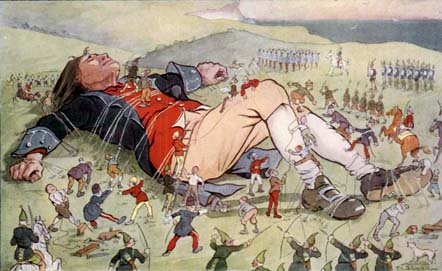
    So in the end it’s not about an ant and an elephant – it’s Gulliver in Lilliput. And the Lilliputians have some strong new ropes: the web.

    Sunday, April 09, 2006

    Eli Noam and Network Integrity

    When I ran my Network Integrity idea past Chuck Cosson, he mentioned a remarkably prescient article by Eli Noam written back in 1994. Prof. Noam wrote:

    “This article argues that the institution of common carriage, historically the foundation of the way telecommunications are delivered, will not survive. To clarify: "common carriers" (the misnomer often used to refer to telephone companies) will continue to exist, but the status under which they operate -- offering service on a non-discriminatory basis, neutral as to use and user -- will not.”

    Noam came to this conclusion by considering the rise of private networks cobbled together out of common carriage components – exactly what we’re seeing cable doing.

    I’ve argued that network integrity is the key Internet attribute that can and should be protected as regulation evolves. I proposed that the lack of effective competition in wireline Internet access justifies the imposition of three requirements on providers: no blocking of access to 3rd party sites, inter-connection with other networks, and transparency in disclosing terms and conditions of service.

    Noam’s policy recommendation of a dozen years ago is remarkably close to my proposal. He concluded that the negative consequences of the demise of common carriage on information diversity and flow could be addressed as follows:

    “A carrier can elect to be private by running its own self-contained infrastructure, and having full control over its content, use and access. But if it interconnects into other networks and accepts transmission traffic from them, it cannot pick some bits over other bits. This means that while a private carrier can be selective in its direct customers, whether they are end-users or content providers, it cannot be selective in what it accepts from another interconnected carrier.”

    In other words, Noam applied the non-blocking requirement to inter-connection with other networks. He didn’t consider prioritization (ie networks delivering some streams faster than others if their source pay extra), as far as I could see. It might not have been so pertinent at that time, since deep packet inspection and traffic shaping wasn’t as cheap as it is now. I wonder how he would’ve responded... My (reluctant) conclusion has been that prioritization is OK, since it’s a continuum – bad behavior can’t be defined a priori. As long as the packets make it across the net, fast and slow lanes are a matter for the market.