Sunday, October 31, 2004

Redistricting - the trend towards bantustan boundaries

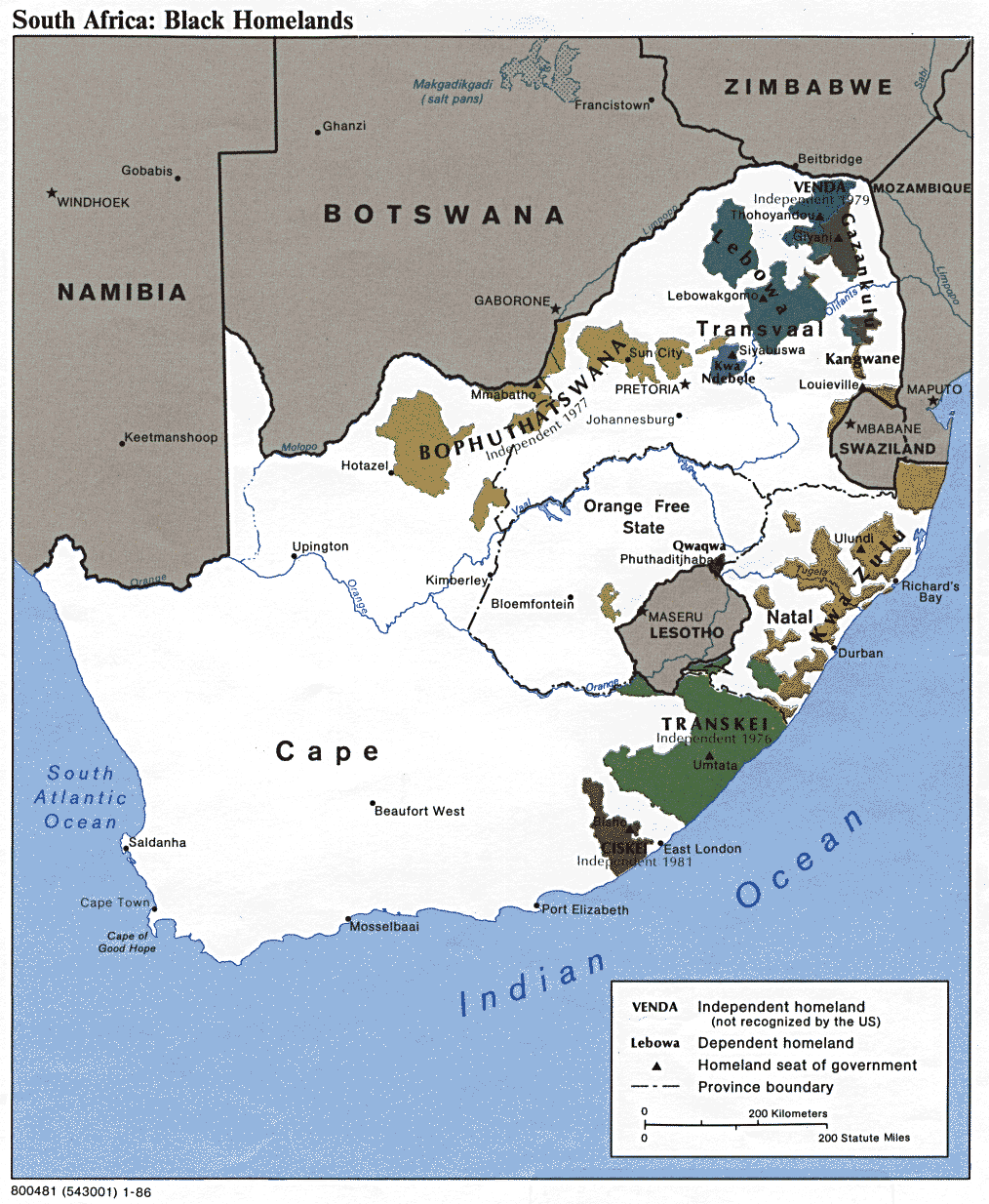
The results of redistricting in the US have been compared to the patchwork bantustans created under apartheid in South Africa: topological monstrosities whose tentacles and fractured edges serve to create homogenized voting blocs where the notion of a district as a conventional geographic entity is completely lost.

For example, on the right is a map of the Pennsylvania district in the the Vieth v. Jubelirer case - the resemblance to an apartheid homeland is uncanny.

The purpose of this gerrymandering is to ensure that incumbents don't lose their seats. According to the LA Times on 31 Oct 2004, "Of the 435 House elections Tuesday, only about four dozen are remotely competitive. Not one of California's 51 House incumbents is in danger of losing his or her seat."

The result is frequently the social and racial homogenization of electoral districts; for example, according to a Boston Globe article by Frank Phillips on 17 August 2004, "voting rights groups forced a major redrawing of Boston's House districts to increase minority political clout." The story notedthat "A three-judge panel concluded in February that the redistricting plan [...] deprived minorities of their voting rights [because] among other inequities, the House plan packed minority voters into an already heavily minority district in Roxbury, while shifting minority voters from nearby districts."

While the maps look the same, there are striking differences between the US and South African experiences.

In America, coming up with crazy cartography is a consensus activity. Although Left and Right may end up on opposite sides of court cases about the specifics, both engage in it, and feel it helps their constituencies. While often racially motivated, US gerrymandering is driven by party political power, which is as more about financial interests and social values than it is about ethnicity.

The foundations of the American practice are also less stable than the apartheid one. Skin color was all that mattered in South Africa, but while American voting habits may correlate from time to time with ethnicity, it keeps changing. A Wall Street Journal story on October 20, 2004 by Jacob Schlesinger describes "emerging signs that a wide swath of voting blocs -- such as women, Latinos, young voters and rural voters -- could behave in unpredictable ways in next Tuesday's election."

With a little luck, this means that the gerrymanderers' best laid plans will always unravel, and that the electoral lock-ins that they crave will never last.

Will electoral districts will ever contract to more coherent shapes? Demographic analysis will continue to become more sophisticated, and the trend to ever-more complex boundaries seems inexorable. Districts will become ever-more fragmented because they can, not because they should. The courts are a countervailing force; to the extent that they refrain from using demographic information to draw boundaries, they will have to fall back on geography, and thus on simpler shapes.

The geography of gerrymandering presents a fascinating opportunity to explore the intersection between political science and complexity theory. The key parameter to track over time will be boundary complexity (measured as fractal dimension, perhaps). It's grown over the last few decades; will it continue to do so? I expect it will. Fortunately, the "If I can think of it, somebody's already done it" Rule, some enterprising political science student has already written their thesis about this. I look forward to finding it; there's already some work on fractals and redistricting.

Sunday, October 10, 2004

Buying - it's magic

Libraries worth of consultant's reports have been written about Why People Buy, and mountains of money have been made by the few who know the answer. I suspect some of it is sympathetic magic.

If I buy a book about losing weight, I'll lose weight. If I buy the book and read it, I have an even better chance! Following the instructions and changing my diet is the final step which most of us never quite get to...

If I buy a big ol' macho truck, it'll make me hunky and virile. It costs more than going to the gym for two hours every day, but it requires a lot less will power.

And the old chestnut: if I buy that product that the film star uses, I'll be beautiful and rich, too.

I'm not sure sympathetic magic is, in fact, the right term. Buying something because its promise will rub off on me is not quite the "like affects like" principle of sympathetic magic, but it's close.

Even though few people practice it explicitly, sympathetic magic is everywhere in behavior and culture. It must be grounded in some hard-wired behavior. It's probably related to our skill in seeing patterns and making connections. Recognizing similarity helps animals get fed and laid; 'that looks like something that tasted good last time', 'that looks like my parent, so it's probably a decent mate'. Science and much of art is driven by the need to explain; and an explanation is just a plausible link between cause and effect. Combine the two, and one has a powerful mechanism: A caused B because A resembled B.

The magic of buying (with the aid of the Post Hoc and Wrong Direction fallacies) is "B talks about A, therefore B causes A".

Friday, September 24, 2004


balloons at twilight
I make the promise again
to go up come Spring

Thursday, September 02, 2004


power lines crackle
feeling what I barely see
the first morning mist

Sunday, August 29, 2004

The importance of reading less

It must be almost a year since my boss said to me in passing
When I fly these days
I no longer try to read
I just sleep, or think

(Just a chance remark, said lightly in passing, but haiku - who knew?)

It's becoming steadily more meaningful to me. Though I never catch up with all the reading I could do, it's so often a convenient excuse for not thinking. (My body doesn't tolerate any excuses for not sleeping.) Now that I make myself think more, or just allow my mind to wander, I've discovered the unexpected pleasure of stumbling over my own ideas.

Saturday, August 28, 2004

iBook ≠iPod

While I was on vacation, I had a few articles on my TabletPC that I'd like to have read. However, I couldn't bring myself to fire it up; its associations with work were so strong that it would've broken the holiday spell.

Every (paper) book I read has a different heft and feel; the covers are different, the pages have different textures, and the associations with each are distinct.

I remember where I read something, not only by where it was on the page and the spread, but how far through the book it was.

Fashion magazines are heavy, glossy, and smell of perfume samples; tabloids are light, fuzzy and disposable.

With music, I don't care how the information is carried; CD, radio, MP3, WMV, ... It doesn't matter. The associations are in what I hear, not what I see or touch.

This is a deep reason why the adoption of digital music has been so much faster than that of electronic books. Reading is a visual experience, and what you see matters. It's also a tactile one: even an e-book has to be held. Profound though subtle connotations are carried by the non-textual packaging. You can close your eyes and listen to the music; how it arrives at your ears doesn't much matter.

In fact, how music is perceived does matter -- your can't get the visceral stimulation of a booming subsonic bass with a headset, and the excitement of a live gig shared with thousands of other fans is lost in solitary listening -- but it matters less than with books.

So what? Digital music (delivered on iPods etc.) will continue to grow, and digital books (read on iBooks etc.) will continue to languish. Video will be a good test case of this theory; it's both visual and aural. I think video is closer to audio than to books; film-makers have told me that audio is an often-underrated part of their impact. They are already consumed in many forms, from cinema to portable DVD players, and this diversity will continue to increase. In some case, the medium carries more of the message than in others.

Friday, August 27, 2004

You might be a geek if

... a fun Friday evening is sitting on the couch with your spouse reading the Voter's Pamphlet for an election you can't vote in

(Apologies to Jeff Foxworthy)

Friday, August 20, 2004


frantic grey sine wave
squirrel across a parched lawn
stops - poised - a fir cone

Thursday, August 19, 2004


summer morning run
into dawn, no sunshine yet
warm days losing light

Tuesday, August 17, 2004

Guilty Pleasures - Typography

I love looking at letters. Chinese script is best; the different fonts you see walking down a street in an Asian city blow my mind, all the better because I don't know what any of it means.

New York Life logoI was stopped in my tracks the other day by the New York Life logo in a bank window. It's a lovely piece of work! It revels in typography -- more than the client might've liked, perhaps -- and creates a quirky yet consistent image. The letters are tied together in a way that seems inevitable, but there are neat tricks. The eye is guided from top left to bottom right by the aligned diagonals, e.g. of the N and the R, and the W; and the link between the Y and the L. I also like the way the L I F E hangs from the first two lines.

Wells Fargo logoThe Wells Fargo logo, on the other hand, is just boring. The "WE" and "AR" ligatures are workmanlike, and the typeface evokes the frontier feel the bank wants to project. Beyond that, though, the only adventure is in the color. A rich amber on a saturated crimson ground; a golden sunset awaits those who trusts their wealth to the stage coach...

Edward Jones logoEdward Jones also had a little fun, contrasting two typefaces. The combination of Bodoni and Franklin Gothic suggests that the organization wants to be seen as both elegant and solid; that it's diverse; and that it might be able to hold two distinct ideas in its head at the same time.

Morgan Stanley logoTo Morgan Stanley, though, just using different shades for the two words was glamour enough. Flair and color is provided by a spurious glyph hanging over the end of "Morgan". Sure, a decent solution for cases when there isn't a tone gamut (faxes happen), but just what is that triangley thing? According to the press release that accompanied the launch of the new logo, it "symbolizes change and the inclination to innovate". Huh? As you probably knew, "[it] points toward the northeast, the general direction of financial success." And last but not least, "[the]three points symbolize the three groups served by the Firm: clients, shareholders and employees." That's a lot of weight for a little blue triangley thing, sorry, "a directional triangle", to bear.
Guilty Pleasures - Psychology Quizzes

OK, yes, I confess: I like to do on-line tests that tell me what I should already know. I complete the quizzes in the hope that they'll provide me with the secret of happiness. All they can tell me, of course, is what I think other people think about me. From time to time, though, I find something useful, like Martin Seligman's Signature Strengths quiz. (The site has long list of other tests, too.)

I linked to it via an interview with Seligman on the Edge site. He argues that psychology has done a great job making people less miserable over the last 50 years by finding effective treatments for 14 major mental illnesses. However, it hasn't done much yet to help people be happier; that what his current research and his book Authentic Happiness is about.

The Seligman test gave me my five "strengths" - while fundamentally not a surprise, it was revealing to see character traits I know well represented as strengths and not as weaknesses. Seligman argues that playing to one's strengths gives you a better chance of getting to a Csikszentmihalyi flow state. I've been trying to figure out how to do this for years, and I was glad to get a hint.

Thursday, August 12, 2004

Horror vacui

If I get too used to sitting quietly, won't I become a slob?

I'm training myself to sit and do nothing. I can pretty much handle stretches of ten minutes now, and I just pulled off a twenty. It's not that my mind wanders -- of course it does, but that's OK since I'm not trying to meditate -- but that I'm constantly assailed by temptations to get up and do something, anything. These urges are so powerful because they're in league with my fear of where a liking for inaction might lead.

I've avoided gambling, smoking and drugs because I might like the experience too much. Even just one taste, and I'll slip down the slope to perdition. (Boy, those adolescent anti-vice ads do work, it seems, at least for some of us.) Logically this doesn't make sense, but emotionally the path is clear: "If I take one pull at the slot machine, I won't be able to stop. I'll enjoy the rush so much that I'll go gambling again, then go every week, then every day. I'll lose my job, and then all my money. I'll turn to crime to support my habit, first shoplifting small items, then robbing widows, and finally becoming a merchant banker. After a humiliating trial I'll be locked up and become Mad Dog Giloollie's love slave, only to escape, go on a rampage, be cornered by the Feds, kill three innocent policemen and two guilty women-and-children in a hostage shoot-out, be shot in the guts and die after seventeen hours of agony."

I'm more tempted by the quiet life than by the more glamorous vices. In his entry for January 31 in "A Vow of Conversation: Journals 1964-1965", Thomas Merton writes:

I can imagine no greater cause for gratitude on my fiftieth birthday than that, on it, I woke up in a hermitage. Fierce cold all night, certainly down to zero, but I have no outdoor thermometer.

Inside the house, it almost froze, though embers still glowed under the ashes in the fireplace. The cold woke me up at one point, but I adjusted the blankets and went back to sleep. What more do I seek than this silence, this simplicity, this "living together with wisdom"? For me, there is nothing else, and to think that I have had the grace to taste a little of what all men seek without realizing it! All the more obligation to have compassion and love, and to pray for them.

What a prospect! But to become hermit would mean giving up my life with S., even if I were to have the courage and compassion to take that path. Sitting and doing nothing inches me closer to that life, but I don't want to pay the price of making that change.

More mundane and more direct, though, is the worry that getting used to doing nothing will make it harder to do something -- anything. I'm an Energizer Bunny powered by a Protestant Work Ethic and a Catholic Guilt Ethic, thumping along determinedly to nowhere in particular. If I stopped running I'd surely become a redneck wife-beater passing my days drinking beer on the porch with a mangy dog while the weeds grow knee-high around the rusted Mustang in the yard.

Sunday, August 08, 2004

Chucking away

I have a few days' vacation, and I'm trying to tidy up my room. It's hard. Every act of throwing away insults something treasured - if it weren't treasured, in even a small way, it would not have been kept. Every scrap repudiated is self-inflicted amnesia. Memories are so fragile that without the help of a memento they fade to nothing without a whisper. It's painfully irrevocable; when the keepsake is lost, the memory goes with it forever.

It's so much easier to accumulate. Every getting and keeping is a thrill: it's Christmas every time. We're all kids who desperately want that new toy on the supermarket shelf, but then can't be bothered to play with it the next day. It's so easy to buy, and the self-storage industry makes it so easy to keep, too.

Creating order requires effort - that much even physics knows. I can't jettison stuff directly; I create new piles of stuff-to-be-junked, hoping that each iteration will reduce the clutter a little. It's a tactile way to think through the decision to discard. A clear desk and tidy shelves are something to be savored, but Oh!, how quickly the entropy of desire takes over.

The hallowed monastic vows of poverty, chastity and obedience prove that making do with little is a challenge on a par with taming lust and submitting to the will of others. It's hard to lead a simple life. Living a complicated life is easy in comparison.

Thursday, August 05, 2004

The most exciting building in Seattle, heaven help us

The only reason the new Central Library in Seattle has been hailed as an architectural masterpiece is that the other buildings in downtown are such crap (with the exception of the Smith Tower, but that was built in 1914).

If an architect can't even get information design right for a library, one shouldn't expect a decent building: there are ink-jet printed directions taped up all over the place. As your grand ascent up the escalator ends, there's one taped to the wall that reads, "This is Level 3". There's a long counter with a row of monitors, their backs to those approaching, each crowned with a glued-on label helpfully declaring, "Librarian". And not to mention this sheet of office paper taped to a non-descript door: "Emergency use only. Alarm will sound."

The place reminds me of the Pompidou in Paris, but without the wit. Exposed ducts and lurid plastic - but set in polished concrete, steel floors and gray-stained wood panels. It tries to be elegant with botanical print carpeting in the "Living Room", it tries to be hip with flourescent yellow escalators, and and it tries to be funky with the meeting room level oppressively colored in nine dark shades of red. The gridded glass panels are boring and blunt, even more so for being painted baby blue. The place is minimalist, but it is embarrassed about it. Think pastel brutalism, or guilty minimalism.

The best part is Ann Hamilton's wooden floor on the 4th Avenue level. The slightly raised lettering not only looks good, it feels great underfoot.

It's fixed

... and it wasn't my fault! It seems that blogger has trouble interpreting blockquotes that aren't properly formatted - like the ones their new blockquote feature creates. Kudos to blogger though; their tech support replied to my mail within three days.